2026 Lettuce Outbreak: Why Food Contamination Spreads Fast
How does a food outbreak spread so fast? It starts with a contaminated field, a centralized packing facility, and a supply chain built for speed.

Introduction
How does a food outbreak spread so fast? The short answer is that the same system designed to get fresh lettuce onto your plate in 48 hours is also remarkably efficient at distributing contamination. A single growing region in California or Arizona supplies leafy greens to grocery stores, restaurants, and meal kit services across the entire country. When something goes wrong at the source, the problem travels with the product.
Think of it like a river with one upstream source that branches into thousands of smaller streams. One contaminated field feeds one packing facility, which ships pallets to dozens of distributors, who split those pallets among hundreds of retailers. By the time the first person gets sick, the lettuce has already scattered across multiple states [1]. Researchers studying these outbreaks describe this as the "amplification effect" of centralized distribution: a small contamination event at the farm level can translate into a geographically massive outbreak within days.
We are seeing this exact amplification effect play out right now. In July 2026, federal health officials traced a massive, multistate outbreak of CyclosporaA microscopic parasite that lives in the intestines and causes cyclosporiasis, a diarrheal illness. It is typically spread through contaminated food or water and cannot be spread directly from person to person., a parasite that causes severe gastrointestinal illness, to a single supplier of shredded iceberg lettuce imported from Mexico. Because that one supplier (reportedly Taylor Farms) fed into the centralized distribution network for Taco Bell, the contaminated lettuce quickly scattered across restaurants in Indiana, Kentucky, Michigan, Ohio, and West Virginia. Before the FDA could even pinpoint the source, the parasite had already sickened over 1,600 people nationwide, with Michigan alone reporting thousands of suspected cases linked to the chain. It is a textbook example of how a single point of failure in a hyper-efficient supply chain can trigger a public health crisis across five states before anyone even realizes the lettuce is tainted.
And the details of how this particular outbreak unfolded are worth sitting with for a moment, because they illustrate just about every vulnerability in the modern food system at once. Shredded iceberg lettuce is not a product most people think of as high-risk. It is not raw meat. It is not shellfish. It is the stuff that comes in a little plastic bag and gets piled into a taco. But that is exactly the point: Cyclospora cayetanensisThe specific species of Cyclospora parasite responsible for most human infections. It is shed in feces and can contaminate produce through irrigation water or handling. Standard water treatment does not always eliminate it. does not care how innocuous the vehicle looks. The parasite, which is shed in feces and can contaminate produce through irrigation water or handling during harvest, is notoriously difficult to wash off because it can adhere tightly to leaf surfaces. Rinsing at home does essentially nothing.
What made this outbreak so hard to catch early is something investigators run into again and again: the incubation period for Cyclospora is typically one to two weeks. That means someone who ate contaminated lettuce at a Taco Bell on a Tuesday might not feel sick until the following Tuesday or even later. By the time they connect their illness to that meal, they may not even remember exactly what they ordered, let alone which restaurant location they visited. Multiply that across thousands of people in five states, and you start to understand why it took investigators as long as it did to identify shredded iceberg lettuce as the culprit rather than, say, the beef or the sour cream.
The scale of Michigan's case count is particularly striking. State health officials reported thousands of suspected cases tied to Taco Bell locations across the state, which is an extraordinary number for a single restaurant chain in a single outbreak. Public health departments were fielding calls faster than they could process them. And because Cyclospora is not routinely tested for in standard stool panels, many cases were almost certainly missed entirely. Patients who saw a doctor, got tested for the usual suspects like Salmonella or E. coli, came back negative, and were sent home without ever knowing they had a parasitic infection. The true case count is likely considerably higher than the official numbers suggest.
There is also the question of what happened on the supplier side. Taylor Farms, which reportedly processed and distributed the shredded lettuce in question, is one of the largest fresh produce suppliers in North America. The company supplies not just fast food chains but grocery stores and food service operations across the country. When a supplier at that scale has a contamination problem, the potential reach is enormous. Investigators had to work quickly to determine whether the contaminated product had moved into other distribution channels beyond Taco Bell, which added another layer of complexity to an already difficult traceback investigation.
For anyone paying attention to food safety, this outbreak is not a surprise so much as a confirmation of something researchers have been warning about for years. The more consolidated the supply chain, the more a single failure point can cascade into a nationwide crisis. And Cyclospora outbreaks linked to imported produce from Mexico are not new. There have been recurring outbreaks tied to cilantro, raspberries, and basil over the past two decades, often tracing back to contaminated irrigation water or poor sanitation practices during harvest. The fact that shredded iceberg lettuce is now on that list suggests the problem is not getting smaller.
Making things more complicated, produce is often commingled, meaning leaves from several different farms get mixed together during processing. When investigators try to trace an outbreak backward through the supply chain, they may find that the bagged salad in question contains lettuce from three different sources. Identifying which one caused the problem becomes significantly harder [1].
Where Contamination Actually Starts (and Why It's So Hard to Find)
Most people imagine food contamination happening in a dirty kitchen, but for leafy greens, the risk often begins long before harvest. Researchers reviewing outbreaks linked to leafy greens between 2009 and 2021 found that contamination sources on farms included irrigation water, wildlife intrusion, and proximity to cattle operations, where E. coli O157:H7A strain of bacteria found in animal intestines that can cause severe foodborne illness in humans, particularly dangerous for people with weakened immune systems. can persist in soil and water for extended periods [2].
Once a pathogen like E. coli or Listeria monocytogenesA bacterium that can survive and even grow in cold, refrigerated environments, making it particularly difficult to eliminate from food processing facilities. enters a processing facility, the problem can compound. A systematic review of Listeria across the produce supply chain found the pathogen present at every stage, from the field to the retail shelf, with some strains persisting in packinghouse environments for years rather than weeks [3]. Whole genome sequencing studies have confirmed that certain Listeria strains essentially take up residence in processing equipment, recontaminating produce batches long after the original source is cleaned up [9].
This matters for anyone with a sensitive gut. People managing IBS or gut hypersensitivity may already have a more reactive digestive system, which can make the consequences of even a low-level exposure feel more severe. Understanding where these pathogens come from is the first step toward understanding why outbreaks are so difficult to prevent entirely.
How Investigators Actually Trace an Outbreak Back to One Farm
When clusters of people start reporting similar symptoms, public health officials begin a process called a traceback investigation, which works essentially like rewinding a film. Investigators start at the point of sale, collect purchase records and receipts, then follow the product backward through distributors, processors, and eventually to the farm [1]. It sounds straightforward, but in practice it can take weeks, partly because supply chain records are often incomplete or inconsistent.
The technological breakthrough that has changed everything is whole genome sequencing, a method that reads the complete genetic code of a bacterial strain. When investigators sequence the bacteria making people sick in Texas, New York, and Oregon and find they share an almost identical genetic fingerprint, that is strong evidence that all three cases trace back to the same source [6]. The European Food Safety Authority describes WGS as the highest-resolution tool available for linking sporadic cases across different geographies to a single point of contamination [6].
A newer approach called a sample-initiated retrospective outbreak investigationAn investigation triggered by genetic sequencing of a food or environmental sample, rather than waiting for enough sick people to be reported first. flips the traditional model. Instead of waiting for a cluster of sick people to trigger an alert, investigators sequence food samples from store shelves or processing environments and work forward from there. This approach can catch outbreaks earlier, before as many people are exposed [4]. Software tools like FoodChain-Lab, developed in Europe, help investigators map the distribution network visually, calculating which nodes in the supply chain are most likely to be the contamination source when epidemiological evidence alone is not enough to decide [5].
Even with these advances, the network model of food distribution means that a single contaminated source can look like multiple separate problems until investigators piece together the full picture [8]. The more centralized the food system, the wider the apparent scatter of cases.
What This Means for Your Gut Health
If you live with IBS or a sensitive digestive system, foodborne outbreaks are not just an abstract public health concern. A gut that is already dealing with hypersensitivity, altered motility, or a disrupted microbiome may respond more intensely to bacterial toxins than a gut in baseline good health. That does not mean you should avoid fresh produce, which offers real nutritional benefits, but it does mean that understanding where your food comes from and how it is handled is genuinely relevant to how you feel.
There are a few practical things worth keeping in mind. Washing pre-washed bagged salad does not meaningfully reduce risk because contamination in most leafy green outbreaks occurs before packaging, often at the field or packing facility level [2]. Buying from local farms with shorter supply chains reduces the number of handling steps between field and fork, which researchers suggest may lower the probability of cross-contamination during distribution [3]. Cooking leafy greens eliminates most bacterial pathogens entirely, though that obviously changes the dish.
Staying informed during active outbreak advisories and checking the FDA's recall database are simple habits that can make a real difference. And if you experience sudden, acute digestive symptoms that feel different from your usual IBS pattern, especially with fever, bloody stool, or significant vomiting, it is worth contacting a healthcare provider rather than assuming it is a routine flare.
How Redbloom Helps
If you have a sensitive gut, you already know that what you eat matters as much as how your food was handled. Many people with IBS or gut hypersensitivity are drawn to capsaicin, the active compound in chili peppers, because research shows it helps reduce gut sensitivity over time by gradually desensitizing the TRPV1 receptors that amplify pain signals in the digestive tract. The challenge is that traditional chili products tend to deliver too much capsaicin too fast, which can trigger discomfort before your gut has a chance to adapt. Redbloom Chili Crisp was built specifically around this problem, for people who want the potential benefits of capsaicin without the shock to the system.
The key difference is in how the capsaicin is delivered. Redbloom microencapsulates capsaicin in oleic acid sourced from avocado oil, creating a protective cushion around each dose. Rather than hitting your gut lining all at once, the capsaicin releases more gradually, which tends to be gentler on sensitive digestive systems. Think of it as the difference between jumping into cold water and easing in slowly. The destination is the same, but the experience along the way is considerably kinder to a gut that is already working hard.
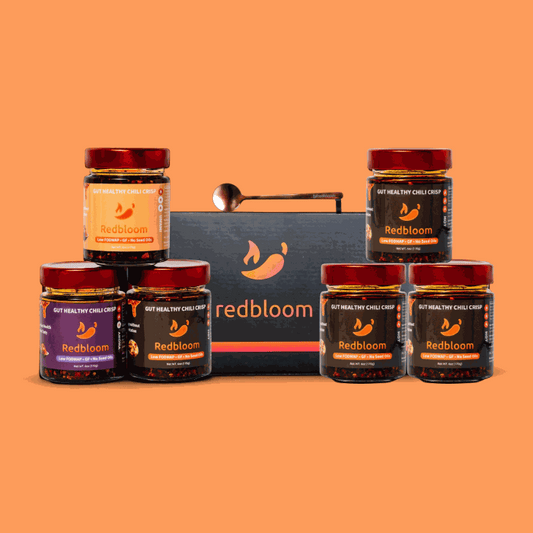
Redbloom also structures the experience as a three-phase protocol: starting with Mild Umami to let your gut get acquainted, moving to Medium Aroma as tolerance builds, and eventually reaching Hot Dopamine for those ready for a fuller heat experience. This graduated approach is designed to build tolerance sustainably rather than overwhelming your system from day one.


Key Takeaways
- Centralized produce distribution means one contaminated farm can cause illnesses across five or more states within days, because the same supply chain built for speed also spreads pathogens efficiently.
- Pathogens like E. coli O157:H7 and Listeria can persist in farm soil and processing facility equipment for months or years, making complete prevention extremely difficult.
- Whole genome sequencing has transformed outbreak investigations by linking sick people across different states to a single bacterial source faster and more accurately than older methods.
- People with IBS or gut hypersensitivity may experience more intense symptoms during a foodborne illness episode, making it worth staying informed about active advisories and recalls.
- Shorter supply chains, cooking leafy greens when possible, and checking the FDA recall database during active outbreaks are practical steps anyone with a sensitive gut can take.
Frequently asked questions
How does a food outbreak spread so fast across multiple states?
It comes down to how centralized produce distribution works. A single farm in California or Arizona supplies leafy greens to distributors who serve retailers and restaurants nationwide. When contamination enters that supply chain, it travels with the product, often reaching dozens of states before the first person even reports feeling sick [1][7]. Researchers describe this as the amplification effect of centralized food systems: a small problem at the source becomes a large, geographically scattered outbreak very quickly [8].
Why is it so hard to trace an outbreak back to a single farm?
Several factors complicate traceback investigations. Produce from multiple farms is often commingled during processing, so a single bag of salad may contain lettuce from three different sources [1]. Supply chain records are frequently incomplete, making it hard to reconstruct exactly where a product came from. And by the time investigators begin working backward, the contaminated product may already be gone from store shelves. Whole genome sequencing has significantly improved investigators' ability to link cases to a common source, but the process still typically takes weeks [4][6].
Does washing pre-washed bagged lettuce make it safer?
Unfortunately, studies suggest that washing pre-washed bagged salad does not meaningfully reduce risk in most leafy green outbreaks. That is because contamination typically occurs before packaging, at the field or packing facility level, and can penetrate leaf surfaces in ways that rinsing at home cannot address [2]. Cooking leafy greens is the most reliable way to eliminate bacterial pathogens, though that changes the dish considerably.
Are people with IBS at higher risk during a food outbreak?
People with IBS or gut hypersensitivity may experience more intense or prolonged symptoms when exposed to foodborne pathogens, partly because their digestive systems are already more reactive. This does not mean avoiding fresh produce, which offers real nutritional value, but it does make staying informed about active outbreak advisories and FDA recalls especially worthwhile. If you experience symptoms that feel meaningfully different from your usual IBS pattern, particularly with fever or significant vomiting, it is worth contacting a healthcare provider rather than assuming it is a routine flare.
How do investigators use whole genome sequencing to solve outbreaks?
Whole genome sequencing reads the complete genetic code of a bacterial strain isolated from a sick person or a food sample. When investigators find that bacteria from patients in different states share an almost identical genetic fingerprint, that is strong evidence they were all exposed to the same contamination source [6]. This method provides far more resolution than older typing techniques, allowing investigators to link what might look like unrelated sporadic cases into a single outbreak and narrow down the likely source much more precisely [4].
Can Listeria survive in a food processing facility for years?
Research suggests it can. Whole genome sequencing studies of produce packinghouses have found evidence that certain Listeria monocytogenes strains persist in processing environments for extended periods, essentially taking up residence in equipment or facility surfaces and recontaminating produce batches long after initial cleaning [9]. A systematic review of Listeria across the fresh produce supply chain found the pathogen present at every stage from field to retail, with outdoor production environments showing the highest prevalence [3]. This persistence is one reason why outbreaks linked to the same facility can recur over time.
What is Cyclospora and why is it so hard to detect?
Cyclospora cayetanensis is a microscopic parasite that lives in the intestines and causes a diarrheal illness called cyclosporiasis. It is typically spread through produce contaminated with fecal matter, often via irrigation water. One of the reasons it is so difficult to catch early is its long incubation period of one to two weeks, meaning people may not feel sick until well after they ate the contaminated food and have forgotten the meal entirely. It is also not included in standard stool testing panels, so many infections are likely missed or misattributed to other causes.
References
- Irvin K, Viazis S, Fields A, et al. An Overview of Traceback Investigations and Three Case Studies of Recent Outbreaks of Escherichia coli O157:H7 Infections Linked to Romaine Lettuce. Journal of Food Protection 2023. [unverified]
- Viazis S, Bazaco MC, Blessington T, Seelman Federman SL, Lindsay M, Minor T, et al. An Overview of Farm Investigation Findings Associated with Outbreaks of Shiga Toxin-Producing Escherichia coli Infections Linked to Leafy Greens: 2009-2021. Journal of food protection 2025.
- Townsend A, Strawn LK, Chapman BJ, Dunn LL. A Systematic Review of Listeria Species and Listeria monocytogenes Prevalence, Persistence, and Diversity throughout the Fresh Produce Supply Chain. Foods (Basel, Switzerland) 2021.
- Wellman A, Bazaco MC, Blessington T, Pightling A, Dwarka A, Hintz L, et al. An Overview of Foodborne Sample-Initiated Retrospective Outbreak Investigations and Interagency Collaboration in the United States. Journal of food protection 2023.
- Weiser AA, Thöns C, Filter M, Falenski A, Appel B, Käsbohrer A. FoodChain-Lab: A Trace-Back and Trace-Forward Tool Developed and Applied during Food-Borne Disease Outbreak Investigations in Germany and Europe. PloS one 2016.
- Koutsoumanis K, Allende A, Alvarez-Ordóñez A, Bolton D, Bover-Cid S, Chemaly M, et al. Whole Genome Sequencing and Metagenomics for Outbreak Investigation, Source Attribution and Risk Assessment of Food-Borne Microorganisms. EFSA journal. European Food Safety Authority 2019.
- Tilashalski FP, Sillence EM, Newton AE, Biggerstaff GK. Enhancing Response to Foodborne Disease Outbreaks: Findings of the Foodborne Diseases Centers for Outbreak Response Enhancement (FoodCORE), 2010-2019. Journal of public health management and practice : JPHMP 2024.
- Jacobs R, Teunis P, van de Kassteele J. Tracing the Origin of Food-Borne Disease Outbreaks: A Network Model Approach. Epidemiology (Cambridge, Mass.) 2020.
- Sullivan G, Orsi RH, Estrada E, Strawn L, Wiedmann M. Whole-Genome Sequencing-Based Characterization of Listeria Isolates from Produce Packinghouses and Fresh-Cut Facilities Suggests Both Persistence and Reintroduction of Fully Virulent L. monocytogenes. Applied and environmental microbiology 2022.
Medical disclaimer
Medical Disclaimer: This article is for informational purposes only and is not intended as medical advice. Always consult with a qualified healthcare provider before making dietary changes or if you have a medical condition.