Can Eating Spicy Food Every Day Change Your Gut Bacteria?

Does spicy food affect gut bacteria? Emerging research suggests the answer is yes, and the effects may be more meaningful than you'd expect.
What Capsaicin Actually Does Inside Your Gut
Does spicy food affect gut bacteria? It's a question researchers have been digging into seriously over the past decade, and the findings are genuinely interesting. The short answer is yes, capsaicin, the active compound in chili peppers, seems to interact with the trillions of microbes living in your digestive tract in ways that may tip the balance toward better gut health.
Here's a useful way to think about it. Your gut microbiomeThe vast community of bacteria, fungi, and other microorganisms living in your digestive tract that influence digestion, immunity, and overall health. is less like a fixed landscape and more like a garden that responds to what you feed it. Capsaicin appears to act like a selective fertilizer, encouraging certain beneficial species while crowding out others that tend to cause trouble.
A 2020 review in Molecules noted that capsaicin seems to eliminate some disease-causing gut pathogens while encouraging the growth of beneficial bacteria, though the authors were careful to point out that much of the data comes from animal models, so translating those findings directly to humans still requires some caution [1]. A more recent integrative review in Metabolites confirmed the general picture: capsaicin tends to favor short-chain fatty acid producers and suppress pro-inflammatory bacterial groups, with both the dose and the individual's sex appearing to shape the response [9].
The Beneficial Bacteria Capsaicin Seems to Favor
One of the most consistently reported findings across multiple studies is that capsaicin tends to increase a beneficial gut bacterium called Akkermansia muciniphila. Think of Akkermansia as a maintenance crew for your gut lining. It lives in the mucus layer of your intestinal wall and helps keep that barrier strong and intact. When your gut lining is healthy, fewer inflammatory compounds can leak into your bloodstream, which is a big deal for people dealing with ongoing digestive discomfort.
Research in mice fed a high-fat diet found that capsaicin treatment was associated with meaningful increases in Akkermansia alongside other beneficial genera, and these shifts were linked to the compound's anti-obesity effects [4]. A separate study also observed increases in Akkermansia along with other bacterial species associated with gut health, suggesting the pattern may be fairly consistent [5].
Beyond Akkermansia, capsaicin also appears to support bacteria that produce short-chain fatty acidsSmall molecules made when gut bacteria ferment fiber; they help reduce inflammation, strengthen the gut lining, and serve as fuel for colon cells., particularly butyrate. Butyrate is essentially premium fuel for the cells lining your colon. It helps reduce inflammation, reinforces the gut barrier, and has been associated with a lower risk of digestive issues. An in vitro study using a model of the human gut microbiota found that regular capsaicin treatment increased microbial diversity and raised levels of butanoic acid (butyrate), with the researchers noting that these effects varied depending on each person's starting microbial community [3].
Another notable mechanism involves the gut barrier itself. Research found that capsaicin may reduce levels of lipopolysaccharide, a pro-inflammatory compound produced by certain bacteria, by decreasing the relative abundance of Proteobacteria species that generate it. At the same time, capsaicin appeared to stimulate the expression of tight junction proteins that literally hold the cells of your gut lining together [7]. A leaky gut lining is thought to contribute to the chronic low-grade inflammation that underlies many digestive complaints, so this finding is worth paying attention to.
The Important Caveat: Dose Makes the Difference
Here's where the story gets a little more nuanced, especially if you have a sensitive gut. The research suggests that capsaicin's effects on your microbiome are strongly dose-dependent, meaning the amount you consume matters enormously.
A 2025 study investigated graded doses of capsaicin over two weeks and found that its impact on gut integrity and microbial ecology was distinctly different at low versus high concentrations. The authors described capsaicin's nature as dualistic: potentially therapeutic at low doses and potentially harmful at higher ones, underscoring the need to understand where the threshold sits for each individual [8].
High-dose chili extract studies paint a similarly cautionary picture. One study found that two weeks of high-dose administration reduced beneficial Firmicutes bacteria and increased Bacteroides in ways that looked like dysbiosis, a disruption of the normal microbial balance. Importantly, that same study found that co-administering a probiotic strain helped attenuate the negative effects [10].
The practical takeaway is that a moderate, consistent amount of capsaicin seems to be where the benefits live. Flooding your system with intense heat all at once is more likely to irritate than to help, particularly if your gut is already sensitive. This is one reason why gradual, controlled exposure tends to produce better outcomes than occasional spicy food binges.
What This Means for People with IBS
If you have IBSIrritable Bowel Syndrome: a common digestive condition characterized by abdominal pain, bloating, and irregular bowel habits without detectable structural damage. or general gut sensitivity, the dose-dependency finding is especially relevant. Your gut may already be in a state of heightened reactivity, which means a large hit of capsaicin could trigger discomfort before any of the beneficial microbiome shifts have a chance to develop. The research suggests that low, consistent exposure over time is the approach most likely to move your microbiome in a positive direction without setting off a flare [9][1].
How Redbloom Helps
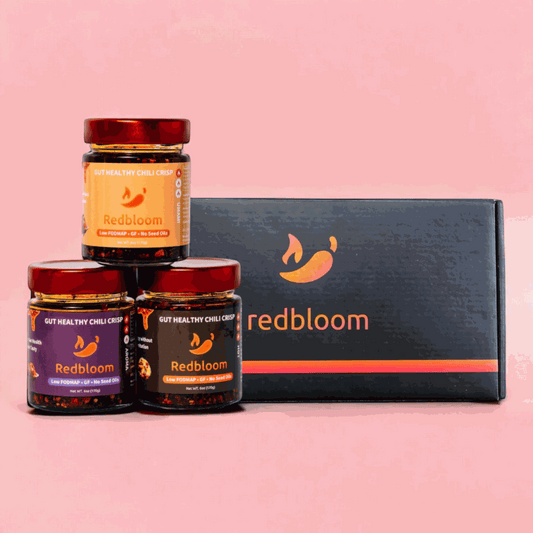
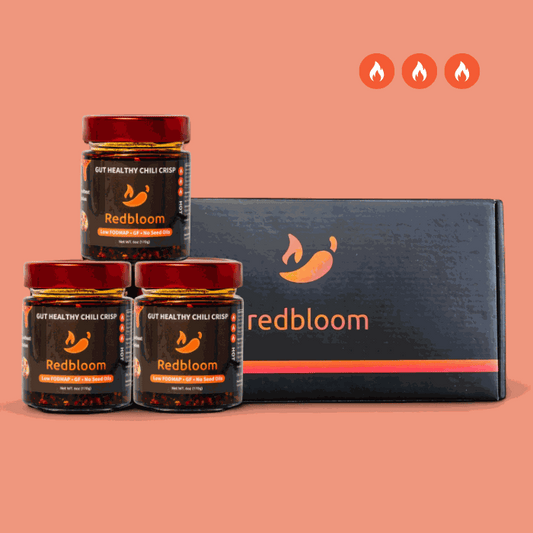
If you've been curious about capsaicin's potential gut benefits but have held back because traditional spicy foods leave you uncomfortable, that tension is exactly what Redbloom Chili Crisp was designed around. Capsaicin activates TRPV1 receptors in your gut and is clinically shown to help reduce gut sensitivity over time with careful, gradual exposure. The problem with most traditional chili products is that they deliver too much capsaicin too fast, which can trigger discomfort before your gut has a chance to adapt and before any of the beneficial microbiome changes have time to take hold.
Redbloom addresses this by microencapsulating capsaicin in oleic acid from avocado oil, creating a protective cushion that releases more gradually and tends to be gentler on sensitive systems. Rather than a sharp, immediate flood of heat hitting your gut lining all at once, the capsaicin is delivered in a slower, more controlled way that gives your digestive tract time to respond without being overwhelmed.
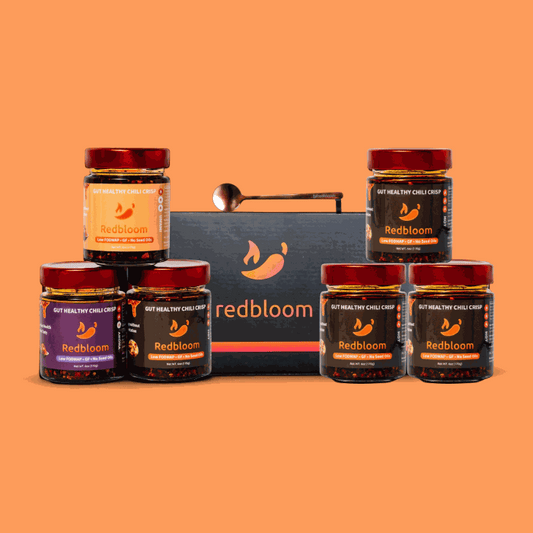
To support that process further, Redbloom uses a structured 3-phase protocol: starting with Mild Umami, moving to Medium Aroma, and progressing to Hot Dopamine. This gradual progression is designed to build tolerance sustainably over time, helping to reduce gut hypersensitivity in a way that works with your biology rather than against it. It's a thoughtful on-ramp for anyone who wants the potential benefits of regular capsaicin exposure without the guesswork of figuring out how much is too much.


Key Takeaways
- Capsaicin may shift your gut microbiome toward beneficial bacteria, particularly species that strengthen the gut lining and reduce inflammation.
- Low to moderate, consistent capsaicin intake appears to be where the benefits are; very high doses may temporarily disrupt gut bacterial balance.
- Your individual microbiome composition influences how you respond, so starting slowly and tracking how you feel is a smart approach.
- Beneficial effects seem to be partly driven by increases in butyrate-producing bacteria and improvements in gut barrier integrity.
- If you have IBS or a sensitive gut, gradual exposure is key: small, consistent amounts over time tend to work better than occasional large doses.
Frequently asked questions
Does spicy food affect gut bacteria in humans, or only in animals?
Most of the detailed mechanistic research has been done in animal models and in vitro (lab) systems, so some caution is warranted when applying those findings directly to humans [9][3]. That said, an in vitro study using a model of the human gut microbiota did find that capsaicin increased microbial diversity and raised short-chain fatty acid levels, suggesting the effects may translate [3]. Human clinical trials on this specific question are still limited, which is why researchers tend to use language like "suggests" rather than "proves" when discussing these findings.
Which gut bacteria does capsaicin seem to increase?
Several studies point to increases in Akkermansia muciniphila, a bacterium associated with gut lining integrity and metabolic health [4][5][6]. Researchers have also observed increases in butyrate-producing species like Faecalibacterium and Roseburia, which help fuel colon cells and reduce inflammation [5][9]. On the flip side, capsaicin appears to reduce certain pro-inflammatory Proteobacteria species [7].
Can eating spicy food every day actually be bad for your gut?
It depends heavily on the dose and your individual sensitivity. At low to moderate amounts, daily capsaicin seems to nudge the microbiome in a beneficial direction [8][3]. At very high doses, research suggests it may temporarily disrupt bacterial balance and compromise gut barrier function [8][10]. If you have a sensitive gut or IBS, starting with small amounts and building up gradually is generally the more sensible approach.
How long does it take for capsaicin to change your gut bacteria?
The research doesn't give a precise human timeline, but animal studies have observed measurable microbiome shifts within a few weeks of consistent capsaicin exposure [2][4]. The key word is consistent: regular, moderate intake over time seems to matter more than occasional large amounts. Your starting microbiome composition also appears to influence how quickly and dramatically things shift [3].
Is spicy food good or bad if you have IBS?
The relationship is genuinely complicated and varies from person to person. Some research suggests that gradual, low-dose capsaicin exposure may help reduce gut hypersensitivity over time by desensitizing TRPV1 receptors [9]. However, large amounts of capsaicin delivered all at once can trigger discomfort, especially during an active flare. If you have IBS, it's worth talking with a healthcare provider before making significant changes to your spice intake. This article is for informational purposes only and is not medical advice.
Does the type of chili product matter for gut bacteria effects?
It likely does. How capsaicin is delivered, including what it's combined with and how quickly it's released in the gut, may influence both tolerability and the downstream effect on your microbiome [9][9]. Products that deliver capsaicin more gradually may be gentler on a sensitive gut while still providing enough exposure to encourage beneficial microbial shifts over time.
References
- Rosca AE, Iesanu MI, Zahiu CDM, Voiculescu SE, Paslaru AC, Zagrean AM. Capsaicin and Gut Microbiota in Health and Disease. Molecules (Basel, Switzerland) 2020.
- Kang C, Wang B, Kaliannan K, Wang X, Lang H, Hui S, et al. Gut Microbiota Mediates the Protective Effects of Dietary Capsaicin against Chronic Low-Grade Inflammation and Associated Obesity Induced by High-Fat Diet. mBio 2017.
- Mahalak KK, Bobokalonov J, Firrman J, et al. Analysis of the Ability of Capsaicin to Modulate the Human Gut Microbiota In Vitro. Nutrients 2022.
- Shen W, Shen M, Zhao X, Zhu H, Yang Y, Lu S, et al. Anti-obesity Effect of Capsaicin in Mice Fed with High-Fat Diet Is Associated with an Increase in Population of the Gut Bacterium Akkermansia muciniphila. Frontiers in microbiology 2017.
- Wang F, Huang X, Chen Y, Zhang D, Chen D, Chen L, et al. Study on the Effect of Capsaicin on the Intestinal Flora through High-Throughput Sequencing. ACS Omega 2020.
- Li J, Liao X, Yin X, Deng Z, Hu G, Zhang W, et al. Gut Microbiome and Serum Metabolome Profiles of Capsaicin with Cognitive Benefits in APP/PS1 Mice. Nutrients 2022.
- Yang J, Li W, Wang Y. Capsaicin Reduces Obesity by Reducing Chronic Low-Grade Inflammation. International Journal of Molecular Sciences 2024.
- Li K, Xu J, Chen S, Du A, Feng S, Yuan S, et al. Dose-dependent Effects of Capsaicin on Intestinal Morphology and Microbiota Composition in Mice: Structural, Immunohistochemical, and Microbial Insights. Veterinary world 2025.
- Corral-Guerrero IA, Martínez-Medina AE, Alvarado-Mata LY, Chávez ACF, Muñoz-García R, Luévanos-Escareño MP, et al. Capsaicin as a Microbiome Modulator: Metabolic Interactions and Implications for Host Health. Metabolites 2025.
- Lertanantawong K, Surawit A, Chattipakorn N, et al. Lactobacillus rhamnosus Attenuates Thai Chili Extracts-Induced Gut Inflammation and Dysbiosis Despite Capsaicin Bactericidal Effect against the Probiotics. PLOS ONE 2021.
Medical disclaimer
Medical Disclaimer: This article is for informational purposes only and is not intended as medical advice. Always consult with a qualified healthcare provider before making dietary changes or if you have a medical condition.