Can Spicy Food Actually Mess With Your Sleep?
Does spicy food affect sleep? The science behind capsaicin, body temperature, and why your late-night heat fix might be costing you rest.

Introduction
Does spicy food affect sleep? If you've ever tossed and turned after a fiery bowl of noodles or woken up feeling like you barely slept, you may already have a personal answer. But researchers have been curious about this question too, and what they've found is genuinely interesting.
In a small but often-cited study published in Physiology and Behavior, six healthy men ate a spicy evening meal containing Tabasco sauce and mustard, then spent the night in a sleep lab. Compared to a non-spicy control meal, the spicy dinner significantly reduced slow wave sleep (the deep, restorative kind your body craves) and stage 2 sleep, while increasing the total time they spent awake. The researchers also noticed that body temperature was elevated during the first sleep cycle after the spicy meal [1].
That detail about temperature is the key to the whole story.
Why Your Body Temperature Is the Real Villain Here
To understand what spice does to your sleep, you first need to know how sleep actually starts. Your body has a built-in cooling system that kicks in as bedtime approaches. Core body temperature naturally dips in the evening, and that drop is one of the main signals your brain uses to shift into sleep mode. Research confirms that this circadian temperature decline is closely tied to sleep onset, and that interventions which help the body lose heat can meaningfully increase deep sleep [7].
Now here's where capsaicin comes in. Capsaicin, the compound that makes chili peppers hot, binds to TRPV1 receptorsTiny protein sensors found in your skin, gut, and brain that detect heat and pain signals, including the heat from capsaicin. throughout your body. These receptors sit at the center of your thermoregulatory system, the network your body uses to manage temperature. When capsaicin activates them, it can interfere with the normal cooling process your body needs to settle into sleep [6][8].
The preoptic area of the brain, a small region in the hypothalamus, coordinates both sleep and thermoregulation. Studies show that TRPV1-sensitive neurons in this area respond directly to capsaicin, and that activating them can disrupt the temperature signals that normally guide you into deep sleep [6][9]. Think of it like trying to fall asleep in a room that's slightly too warm. Your body keeps trying to cool down, and sleep keeps getting interrupted.
Animal research adds another layer to this picture. Studies in rats found that capsaicin changes the pattern of brain rhythms specifically during sleep stages, without affecting waking brain activity, which suggests the disruption is not just about feeling uncomfortable but about something happening at a neurological level [4]. Separate work found that when capsaicin receptors were selectively removed, animals showed changes in both slow wave sleep and REM sleep, pointing to a direct role for TRPV1 in shaping sleep architecture rather than just a side effect of feeling hot [5].
Does Timing Make a Difference?
Here is some genuinely reassuring news: the timing of your spicy meal seems to matter quite a bit. The disruption observed in the 1992 study happened when participants ate spice in the evening, close to when they went to bed [1]. The body temperature spike that interfered with sleep occurred during the first sleep cycle, suggesting the capsaicin was still actively affecting thermoregulation in the early hours of the night.
There is also a molecular twist worth knowing about. When TRPV1 receptors are activated by capsaicin, they appear to trigger changes in the body's endocannabinoid system, a network of signaling molecules involved in both temperature regulation and sleep. Research suggests this interaction may contribute to how capsaicin shapes sleep architecture, though the full picture is still being worked out [10].
What this means practically is that enjoying spicy food at lunch or in the early afternoon gives your body more time to process the capsaicin and return to its normal thermal baseline before sleep. For people with sensitive guts or IBS who are already navigating what they can eat and when, this timing consideration is worth adding to the toolkit.
A Note on Individual Variation
Not everyone will notice a dramatic effect. The study that started this conversation involved only six participants, so it's fair to hold the findings with some curiosity rather than treating them as universal law [1]. Factors like your personal spice tolerance, how much you ate, and your overall gut sensitivity likely all play a role. People with visceral hypersensitivityA condition common in IBS where the nerves in the gut are more reactive than usual, making normal sensations feel painful or uncomfortable. may find that the gut discomfort from a spicy evening meal compounds the sleep disruption, creating a cycle that's harder to break.
Practical Steps If Spicy Food Is Messing With Your Rest
The research does not suggest you need to give up spice entirely. It suggests being thoughtful about when and how much you eat. A few evidence-informed ideas worth considering:
- Shift spicy meals earlier in the day. Eating spice at lunch rather than dinner gives your body hours to process before your core temperature needs to drop for sleep.
- Watch the portion size at night. A small amount of capsaicin is likely less disruptive than a large one, especially if you're eating close to bedtime.
- Keep your sleep environment cool. Since the problem seems to be thermoregulatory, helping your body lose heat through a cool room or lightweight bedding may offset some of the effect [7].
- Track your own patterns. If you have IBS or a sensitive gut, keeping a simple log of what you ate, when, and how you slept can help you identify your personal threshold.
The goal is not restriction for its own sake. It's understanding the relationship between what you eat and how you feel, so you can make choices that actually work for your body.
How Redbloom Helps
If you love spicy food but your gut makes you pay for it, the problem often isn't capsaicin itself. It's how it's delivered. Traditional chili products tend to hit your system with a large, sudden dose of capsaicin, which can overwhelm sensitive gut receptors before your body has any chance to adapt.
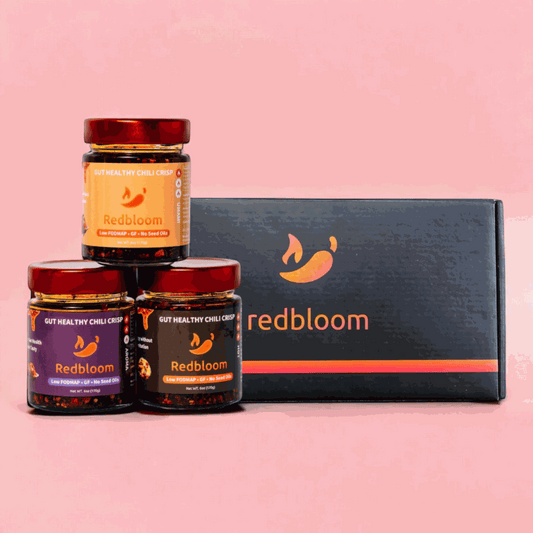
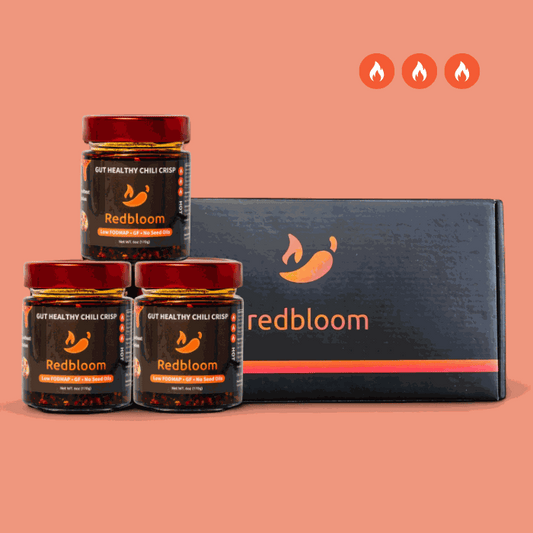
Redbloom Chili Crisp takes a different approach. Capsaicin is microencapsulated in oleic acid from avocado oil, which creates a gentler, more gradual release that tends to be easier on sensitive guts. The idea is to let your TRPV1 receptors adapt rather than get ambushed.
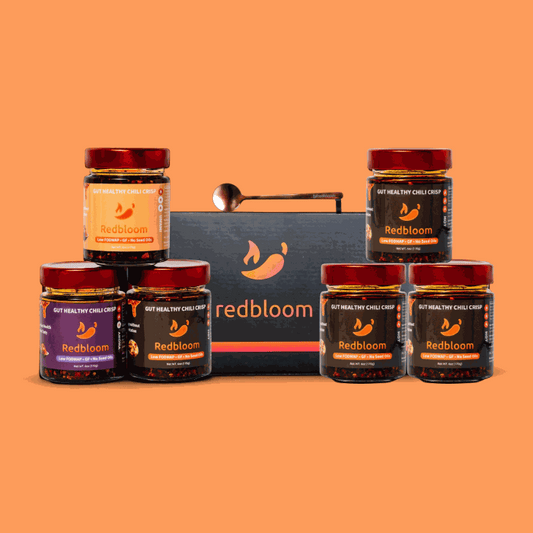
Redbloom also uses a structured 3-phase protocol: Mild Umami first, then Medium Aroma, then Hot Dopamine. This graduated progression is designed to build tolerance gradually over time, which is consistent with research suggesting that careful, repeated exposure to capsaicin may help reduce gut hypersensitivity rather than worsen it. For people navigating IBS or digestive sensitivity, that kind of intentional approach can make the difference between enjoying spice and avoiding it altogether.
And if you're thinking about sleep: eating Redbloom earlier in the day, when your body has time to process before bedtime, is a simple way to enjoy the flavor without the nighttime thermoregulatory interference the research points to.


Key Takeaways
- Spicy food eaten close to bedtime may raise core body temperature and disrupt deep, restorative sleep, according to research.
- Capsaicin activates TRPV1 receptors that are directly involved in both thermoregulation and sleep architecture, so the effect goes beyond just feeling uncomfortable.
- Shifting spicy meals to earlier in the day is one of the simplest ways to enjoy heat without paying for it at night.
- People with IBS or visceral hypersensitivity may be more vulnerable to sleep disruption from evening spice, since gut discomfort can compound the thermoregulatory effect.
- Gradual, controlled capsaicin exposure over time may help reduce gut sensitivity, making spicy foods easier to tolerate in the long run.
Frequently asked questions
Does spicy food affect sleep for everyone, or just some people?
Research suggests the effect is real but varies from person to person. The most-cited study found significant sleep disruption in a small group of healthy men after a spicy evening meal [1], but individual factors like spice tolerance, gut sensitivity, and meal timing all likely influence how much any given person is affected. People with IBS or visceral hypersensitivity may notice a stronger impact.
How long before bed should I stop eating spicy food?
There's no hard cutoff established in the research, but the sleep disruptions observed in studies were linked to body temperature elevation during the first sleep cycle, suggesting the capsaicin was still active shortly after the meal [1]. Giving yourself at least three to four hours between a spicy meal and bedtime seems like a reasonable starting point, though your own patterns are the best guide.
Can spicy food cause nighttime gut symptoms that wake me up?
It can, particularly for people with IBS or sensitive digestive systems. Capsaicin activates TRPV1 receptors throughout the gut, which can speed up gut motility and increase sensations of urgency or discomfort [5][9]. If nighttime gut symptoms are disrupting your sleep, that's worth tracking and potentially discussing with a healthcare provider.
Will I sleep better if I build up a tolerance to spice?
Possibly. Research suggests that gradual, repeated exposure to capsaicin can desensitize TRPV1 receptors over time, which may reduce both gut discomfort and some of the thermoregulatory response [5]. If your body is less reactive to capsaicin overall, the sleep-disrupting effects of an evening meal may become less pronounced. Building that tolerance slowly and consistently tends to work better than occasional large doses.
Is it just the heat, or does capsaicin affect the brain directly during sleep?
Both seem to be involved. Animal studies found that capsaicin changes brain wave patterns specifically during sleep stages, not during waking, which points to a neurological effect beyond just feeling warm [4]. Capsaicin-sensitive neurons in the preoptic area of the brain, a region that coordinates both sleep and temperature regulation, appear to play a direct role [6][8]. The full picture is still being explored, but the effect is likely more than just discomfort.
Does cooling down my bedroom help if I've eaten spicy food?
It might. Since the core issue seems to be that capsaicin interferes with your body's natural temperature drop at bedtime, anything that helps your body lose heat could offset some of the disruption. Research on sleep and thermoregulation shows that enhanced body heat loss can meaningfully increase deep sleep [7], so a cooler room, lighter bedding, or even a cool shower before bed may help on nights when you've eaten spicy food later than planned.
References
- Edwards SJ, Montgomery IM, Colquhoun EQ, Jordan JE, Clark MG. Spicy meal disturbs sleep: an effect of thermoregulation?. International journal of psychophysiology : official journal of the International Organization of Psychophysiology 1992.
- Gulia KK, Mallick HN, Kumar VM. Ambient temperature related sleep changes in rats neonatally treated with capsaicin. Physiology & behavior 2005.
- Obál F, Tobler I, Borbély AA. Effect of ambient temperature on the 24-hour sleep-wake cycle in normal and capsaicin-treated rats. Physiology & behavior 1983.
- Liu L, Tian Y. Capsaicin Changes the Pattern of Brain Rhythms in Sleeping Rats. Molecules (Basel, Switzerland) 2023.
- Kumar V, Kumar D, Mallick H, Gulia K. Capsaicin Receptors in Sleep Regulation. Sleep and Vigilance 2022.
- Rothhaas R, Chung S. Role of the Preoptic Area in Sleep and Thermoregulation. Frontiers in neuroscience 2021.
- Herberger S, Penzel T, Fietze I, Glos M, Cicolin A, Fattori E, et al. Enhanced conductive body heat loss during sleep increases slow-wave sleep and calms the heart. Scientific reports 2024.
- Fischer MJM, Ciotu CI, Szallasi A. The Mysteries of Capsaicin-Sensitive Afferents. Frontiers in physiology 2020.
- Okamoto-Mizuno K, Mizuno K. Sleep and thermoregulation. Journal of Physiological Anthropology 2012.
- Manchanda M, Leishman E, Sangani K, Alamri A, Bradshaw H. Activation of TRPV1 by Capsaicin or Heat Drives Changes in 2-Acyl Glycerols and N-Acyl Ethanolamines in a Time, Dose, and Temperature Dependent Manner. Frontiers in Cell and Developmental Biology 2021.
Medical disclaimer
Medical Disclaimer: This article is for informational purposes only and is not intended as medical advice. Always consult with a qualified healthcare provider before making dietary changes or if you have a medical condition.