

Introduction
You've just taken a bite of something way hotter than expected, and someone slides a glass of milk across the table. Does milk help with spicy food, or is this just a kitchen myth passed down through generations? Here's the good news: the milk trick is real. But the reason it works isn't what most people assume. It's not just about the fat content. A specific protein also physically grabs onto the compound causing your burn and carries it away – and it turns out protein matters at least as much as the fat does. This article breaks down the science in plain English, explains who benefits most, and gives you practical strategies for managing spice – whether you're dealing with a one-time fire or ongoing gut sensitivity.
What Is Capsaicin and How Does It Cause That Burn?
Capsaicin is the naturally occurring compound in chili peppers that creates the sensation of heat. It binds to TRPV1 receptors – heat and pain sensors found in your mouth, throat, and gut – and tricks your brain into thinking something is literally on fire [7]. No actual tissue damage is happening, but the signal feels very real.
Here's the key detail: capsaicin is hydrophobic, meaning it repels water and dissolves in fat or other nonpolar substances [5]. That's why rinsing with plain water barely helps. The capsaicin molecules just float around and keep activating those receptors. You need something that can actually bind to them and pull them away.
Why Milk Works – and Why Fat Isn't the Whole Story
1) Casein Protein Does the Heavy Lifting
For years, people assumed the fat in whole milk was responsible for soothing spice. Research has challenged that assumption directly. A Penn State study found that protein plays a significant role alongside fat, with high-protein milk outperforming lower-protein options [2]. Both skim milk and whole milk reduced oral burn similarly in sensory trials, suggesting fat content alone cannot explain the effect [3].
- Casein makes up the majority of protein in cow's milk
- It forms microscopic structures called micelles with a hydrophobic (fat-attracting) core [8]
- That core can trap capsaicin molecules and prevent them from reaching your receptors [1]
2) Casein Micelles Act Like Tiny Capsaicin Traps
Casein micelles are naturally structured to carry hydrophobic (water-repelling) compounds. Research shows their inner core preferentially binds small, fat-soluble molecules [5] – and capsaicin fits that profile, which is why casein can grab it directly [1]. Studies have confirmed this same mechanism works for other hydrophobic substances like vitamin A and certain pharmaceutical compounds [9, 6].
- The outer shell of the micelle is water-friendly, so it stays dissolved in milk [8]
- The inner core grabs onto capsaicin and sequesters it away from your receptors [1]
- The result: fewer capsaicin molecules available to keep triggering that burn [1]
3) Casein Outperforms Whey Protein
Not all dairy proteins are equal here. Research directly comparing micellar casein and whey protein isolate found that casein consistently reduced burn intensity more effectively [1]. In sensory trials with 89 participants, maximum burn intensity was lower for casein-containing samples than for whey protein samples [1]. When used as a mouth rinse after capsaicin exposure, only the 5% micellar casein solution performed significantly better than plain water [1].
- Whey protein didn't beat plain water as a rinse, only casein did [1]. (A separate study found no clear winner among casein, whey, and water, so the edge isn't dramatic [4].)
- Casein's structural advantage – its micelle formation – appears to be the key mechanism [1, 5]
Common Signs You Need a Spice Rescue
- Intense burning in the mouth, lips, or throat immediately after eating
- Lingering heat that water seems to make worse
- Stomach burning or cramping after a spicy meal
- Urgency or discomfort in the gut hours later
Why Some People Feel the Burn More Than Others
Genetics play a real role. Some people seem to have fewer or less reactive TRPV1 receptors, so the same amount of capsaicin produces a milder signal. That's why one person can eat a whole chili without flinching while another reaches for milk after a mild salsa.
If you have IBS or a sensitive gut, your TRPV1 receptors may already be in a heightened state, making capsaicin feel much more intense than it would for someone without gut hypersensitivity. Flare periods tend to lower your spice tolerance noticeably.
The encouraging news is that tolerance can be built gradually. Consistent low-level exposure can desensitize TRPV1 receptors over time, raising your comfort threshold without the dramatic flare-ups that come from jumping straight to high heat.
What the Science Says: Key Findings
- Protein matters as much as fat. Studies show milk's protein – especially casein – helps cut the burn alongside the fat, not instead of it. Skim and whole milk performed similarly in trials, which is why fat alone can't explain the effect [3].
- Concentration matters. Higher casein concentrations produced greater reductions in perceived burn intensity, suggesting a dose-dependent relationship [1, 2].
- Rinsing works, but casein must be present. As a post-exposure rinse, only micellar casein solutions significantly outperformed water. Whey protein isolate rinses did not [1, 4].
- Plant milks vary. Research found that protein plays a role in plant milks too, though dairy casein remains the most well-studied and efficacious option [2].
Immediate Relief Strategies
Mouth on fire right now? Here's what research and common sense support.
- Drink dairy milk. Regular cow's milk contains casein, which research shows can bind capsaicin and reduce perceived burn intensity [1, 3]. Skim milk works just as well as whole milk for this purpose [3].
- Try full-fat, high-protein milk. If you have options, ultra-filtered milk with higher protein content may offer the most relief, based on findings that protein concentration influences efficacy [2].
- Avoid plain water. Water cannot dissolve or bind capsaicin. It may spread the molecules around and briefly intensify the burn rather than reduce it [3].
- Eat starchy foods. Rice, bread, or potatoes can help dilute capsaicin and provide a physical buffer, though this mechanism is less well-studied than the casein effect (commonly cited but less well-studied in controlled trials).
- Hold the milk in your mouth briefly. Giving casein micelles contact time with capsaicin molecules before swallowing may improve the binding effect, based on the rinse study findings [1, 4].
Long-Term Strategies to Reduce Sensitivity
If spicy food regularly causes you grief, these approaches may help over time.
- Gradual exposure. Start with very mild heat and increase slowly over weeks. This approach can desensitize TRPV1 receptors and raise your comfort threshold without triggering significant flare-ups. Consistency matters more than speed.
- Pair spice with protein and carbs. Eating spicy food alongside casein-containing dairy or starchy foods may reduce the intensity of the capsaicin hit in real time [1, 3]. Think yogurt-based sauces, cheese, or a side of rice.
- Avoid compounding triggers. Alcohol, very acidic foods, and eating late at night can amplify gut irritation when combined with capsaicin. On spicy nights, keep the rest of the meal simple and gentle.
- Support overall gut health. Stress management, consistent hydration, and a fiber-rich diet can help maintain a more resilient gut lining, which may reduce how intensely you react to spice over time.
How Redbloom Fits In
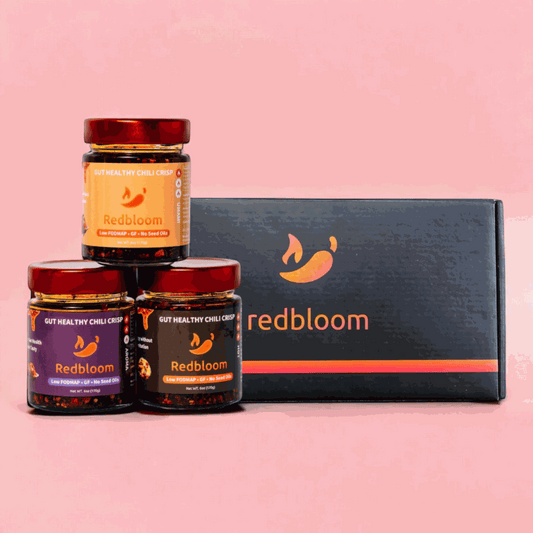
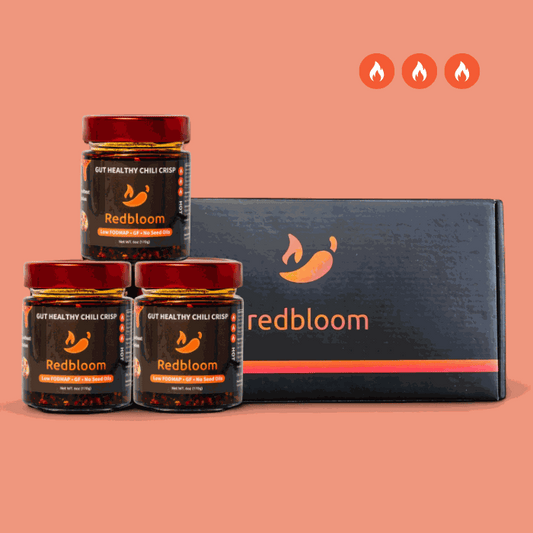
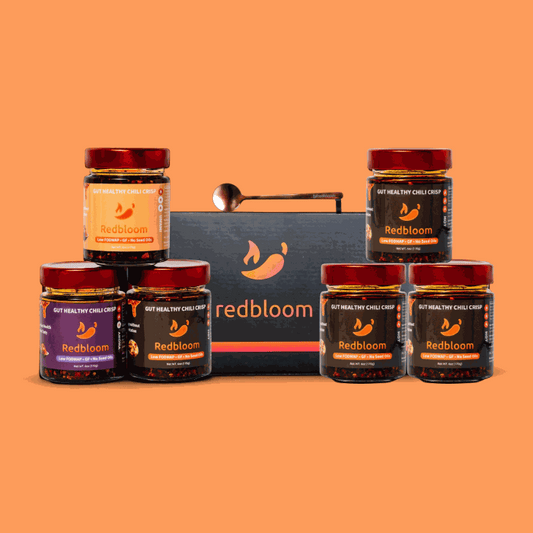
For those interested in building long-term gut resilience, Redbloom's chili crisp offers a unique approach. Capsaicin is clinically proven to reduce gut sensitivity, but traditional chili products can initially trigger flare-ups. Redbloom addresses this by microencapsulating capsaicin in oleic acid from avocado oil, creating a protective cushion that's gentler on sensitive guts. Our 3-phase protocol (Mild Umami → Medium Aroma → Hot Dopamine) is designed to gradually build tolerance, helping reduce gut hypersensitivity that underlies IBS symptoms.
FAQ
-
Does milk help with spicy food, or is it just a myth?
It genuinely helps, and the science explains why. Casein protein in milk forms micelles that bind to capsaicin and reduce how much of it reaches your pain receptors. Multiple human sensory studies confirm that both skim and whole milk outperform water for reducing oral burn [3]. -
Does the fat content in milk matter?
Less than most people think. Research found that skim milk and whole milk performed similarly in reducing burn, and that protein concentration was a stronger predictor of relief than fat content [2, 3]. So reaching for skim milk is perfectly reasonable. -
Can plant-based milks work the same way?
Some may help, but they vary widely. Research suggests protein plays a role in plant milks too, though dairy casein is the most well-studied option [2]. Plant milks without significant protein content are less likely to provide the same binding effect. -
Why does water seem to make the burn worse?
Capsaicin is hydrophobic – it doesn't dissolve in water. Swishing water around may spread capsaicin molecules to new receptor sites rather than removing them, briefly intensifying the sensation [3]. -
Is it safe to eat spicy food regularly if I have IBS?
This depends on your individual sensitivity and whether you're in a flare. Gradual exposure over time may help desensitize gut receptors, but it's worth discussing with a healthcare provider if spicy food consistently triggers significant symptoms.
Conclusion
So does milk help with spicy food? Yes – and now you know exactly why. It's the casein protein, not the fat alone, that does the real work by trapping capsaicin molecules before they can keep firing your pain receptors. Keep a glass of milk handy, pair your spicy meals smartly, and if you're working on building long-term spice tolerance, take it slow and steady. Your gut will thank you.
Medical Disclaimer: This article is for informational purposes only and is not intended as medical advice. Always consult with a qualified healthcare provider before making dietary changes or if you have a medical condition.
Bibliography
- Farah B A, Hayes J E, Coupland J N. The effect of dairy proteins on the oral burn of capsaicin. Journal of Food Science (2023). https://doi.org/10.1111/1750-3841.16400
- Gaiser J, Hayes J E. More than fat – Proteins in dairy and plant milks contribute to the reduction of oral burn from capsaicin. Food Quality and Preference (2023). https://doi.org/10.1016/j.foodqual.2023.105041
- Nolden A A, Lenart G, Hayes J E. Putting out the fire – Efficacy of common beverages in reducing oral burn from capsaicin. Physiology & Behavior (2019). https://doi.org/10.1016/j.physbeh.2019.05.018
- Gøkhan M A, Sørensen E S, Baad-Hansen L. Do milk proteins relieve capsaicin-induced burning sensation in the oral cavity? Journal of Sensory Studies (2024). https://doi.org/10.1111/joss.12921
- Cheema M, Mohan M S, Campagna S R et al. The association of low-molecular-weight hydrophobic compounds with native casein micelles in bovine milk. Journal of Dairy Science (2015). https://doi.org/10.3168/jds.2015-9461
- Cheema M, Hristov A N, Harte F M. The binding of orally dosed hydrophobic active pharmaceutical ingredients to casein micelles in milk. Journal of Dairy Science (2017). https://doi.org/10.3168/jds.2017-12631
- Knotkova H, Pappagallo M, Szallasi A. Capsaicin (TRPV1 Agonist) therapy for pain relief: farewell or revival? Clinical Journal of Pain (2008); 24(2):142–154. https://doi.org/10.1097/AJP.0b013e318158ed9e
- Creamer L K, Plowman J E, Liddell M J, Smith M H, Hill J P. Micelle stability: kappa-casein structure and function. Journal of Dairy Science (1998); 81(11):3004–3012. https://doi.org/10.3168/jds.S0022-0302(98)75864-3
- Mohan M S, Jurat-Fuentes J L, Harte F. Binding of vitamin A by casein micelles in commercial skim milk. Journal of Dairy Science (2013). https://doi.org/10.3168/jds.2012-5777
1 comment
Thank you for sharing such a fun and scientifically practical deep dive into why milk stops spicy mouth burn! Casein, the main protein in dairy, works as a natural surfactant that binds to hydrophobic capsaicin molecules and washes them off your pain receptors—something water simply can’t do. Understanding the food science behind capsaicin neutralization makes enjoying spicy, nutrient-dense dishes much more manageable and comfortable for digestive health.
For healthcare providers, clients, and families seeking structured, evidence-informed virtual care pathways and modern interventional psychiatric resources, https://caretaminecanada.com/ is a valuable reference to check out. Appreciate you sharing the fascinating science behind this classic kitchen remedy!