Introduction
Stocking up on peppers for your gut health routine but wondering if frozen peppers vs fresh makes a difference? You're not alone. Many people assume fresh is always better, but research reveals a more nuanced picture. The way peppers are processed and stored can actually alter their capsaicin content and how well your body absorbs these beneficial compounds. This article breaks down what science shows about frozen versus fresh peppers, how processing affects capsaicin bioaccessibility, and which option might work better for your digestive goals.
What Is Capsaicin and How Does It Affect Your Gut?
Capsaicin is the compound that gives peppers their heat, but it's also a bioactive molecule with potential gut health benefits. When you eat capsaicin, it binds to TRPV1 receptors – heat and pain sensors found throughout your digestive tract. [1]
Research suggests capsaicin may help reduce gut sensitivity over time, though the initial response can feel intense for people with sensitive stomachs. [1] The key factor isn't just how much capsaicin a pepper contains, but how much your body can actually absorb and use – what scientists call bioaccessibility.
Processing methods like freezing, heat treatment, and storage can significantly alter both capsaicin concentrations and how easily your digestive system can access these compounds. [1]
Why Processing Affects Capsaicin Content
1) Cellular Structure Changes
Freezing causes ice crystals to form inside pepper cells, which can rupture cell walls and alter how capsaicin is stored and released. Research indicates that processing methods can affect capsaicin content in green jalapeños during storage. [1]
- Ice crystal formation breaks down cellular barriers
- Changes how capsaicin is bound within pepper tissues
2) Bioaccessibility Shifts
The bioaccessibility of capsaicinoids – how much your body can actually absorb in vitro – is significantly altered by processing treatments. Heat processing generally decreases bioaccessibility, while fresh green peppers show the highest capsaicinoid bioaccessibility. [1]
- Processing can make capsaicin easier or harder to absorb
- Fresh peppers show superior absorption compared to processed varieties
3) Preservation vs Degradation
Different preservation methods affect capsaicin stability differently. Research on freeze-drying shows it can effectively maintain capsaicinoid levels, with capsaicin content varying significantly depending on the pepper variety.
- Freeze-drying preserves bioactive compounds well
- Some processing methods are gentler than others
Common Signs Your Body Is Absorbing Capsaicin
Whether from fresh or frozen peppers, you'll know capsaicin is reaching your system when you experience:
- Initial burning sensation in mouth and throat
- Mild stomach warmth or tingling
- Increased saliva production
- Slight sweating response
- Temporary changes in digestion speed
Why Fresh vs Frozen Affects Your Experience
Tissue Concentration Differences
Fresh peppers have capsaicin concentrated mainly in the placenta (the white part where seeds attach), with significantly higher levels compared to the outer flesh. Research shows ornamental peppers contain capsaicin levels ranging from 0-6.79 mg/g across different tissues, with the placenta having the highest concentrations. [7]
Processing Tolerance
Some people find frozen peppers gentler on their digestive system, possibly because freezing slightly alters the capsaicin release pattern. The cellular changes from freezing may create a more gradual release compared to fresh peppers' immediate impact.
Storage Duration Effects
Frozen peppers stored for different lengths of time may have varying capsaicin profiles. Storage duration can affect both potency and tolerance levels. [1]
What the Science Says: Key Findings
Research comparing fresh and processed peppers reveals several important patterns for gut health applications. [1]
Fresh Pepper Advantage: Fresh green peppers showed the highest capsaicinoid bioaccessibility in laboratory testing, while cooking treatments reduced the amount of capsaicin available for absorption. [1]
Bioaccessibility Changes: Processing treatments significantly alter how much capsaicin your body can absorb, with heat processing generally reducing bioaccessibility while fresh peppers maintain optimal levels. [1]
Preservation Success: Freeze-drying effectively maintains bioactive compounds including capsaicinoids, demonstrating that some processing methods can preserve beneficial properties. [6]
Variety Matters: Different pepper types respond differently to processing, with some varieties like habanero maintaining higher capsaicin levels regardless of treatment method. [5]
Immediate Strategies for Better Absorption
1) Choose Your Timing
If using frozen peppers, consider how long they've been stored. Processing can affect capsaicin availability, so fresh peppers may offer more predictable potency. [1]
2) Include Healthy Fats
Capsaicin is fat-soluble, so pairing peppers with healthy oils or avocado can improve absorption. Research on dietary fats shows they can enhance capsaicinoid bioaccessibility. [1]
3) Start with Milder Processing
If you're sensitive to spice, consider that fresh peppers provide the most predictable capsaicin delivery, though they may be more intense initially.
4) Focus on Preparation Method
Avoid high-heat cooking methods that can degrade capsaicin content. Gentle heating or using peppers in room-temperature applications preserves more bioactive compounds. [2]
Long-Term Strategies for Optimal Benefits
1) Gradual Exposure Approach
Use the natural variation in pepper potency to your advantage. Start with milder varieties and progress to more potent ones as your tolerance builds. This mimics clinical protocols that gradually increase capsaicin exposure. [1]
2) Diversify Your Sources
Rotate between fresh and frozen peppers to expose your system to different capsaicin release patterns. This variety may help build more robust tolerance over time.
3) Track Your Response
Keep notes on how different pepper preparations affect your digestion. Some people respond better to the altered capsaicin profile in frozen peppers, while others prefer fresh varieties.
4) Optimize Storage Practices
If freezing fresh peppers at home, consider portioning them by intended use. Remember that fresh peppers generally provide the highest bioaccessibility of beneficial compounds.
How Redbloom Fits In
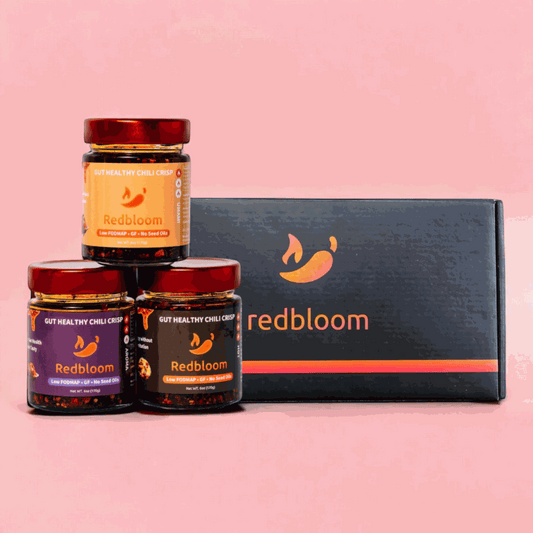
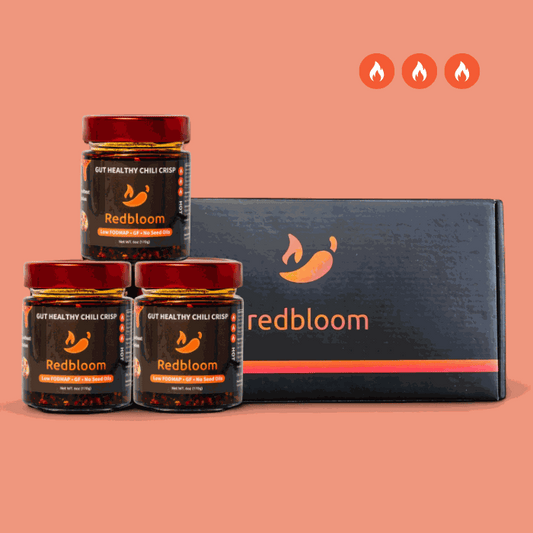
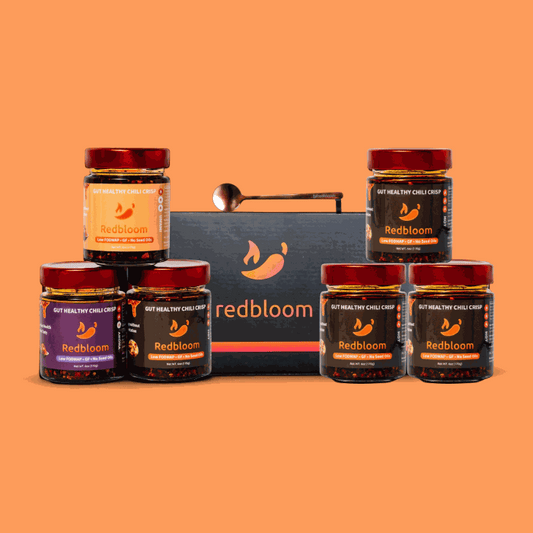
For those interested in building long-term gut resilience, Redbloom's chili crisp offers a unique approach. Redbloom microencapsulates capsaicin in oleic acid from avocado oil, which creates a protective cushion that's gentler on sensitive guts. Our 3-phase protocol is designed to gradually build tolerance, helping reduce gut hypersensitivity that underlies IBS symptoms. Learn more about Redbloom's approach.
FAQ
1) Are frozen peppers less nutritious than fresh ones?
Research shows that fresh peppers provide the highest bioaccessibility of capsaicinoids, while processing treatments like freezing can reduce how much your body can absorb. [1,6]
2) How long can I store frozen peppers while maintaining their gut benefits?
Processing affects capsaicin availability over time. [1] For consistent benefits, fresh peppers are generally recommended, but frozen peppers used within 3-6 months can still provide benefits.
3) Should I remove seeds and placenta from frozen peppers?
The placenta (white part) contains the highest capsaicin concentrations across pepper tissues, so removing it reduces potency significantly. [7] Keep it if you want maximum gut benefits but can handle the heat.
4) Do frozen peppers work better for sensitive stomachs?
Some people find frozen peppers gentler, possibly because cellular changes from freezing alter how capsaicin is released. [1] The effect varies by individual, so experiment carefully.
5) Can I get the same gut benefits from pepper powders or dried peppers?
Processing methods significantly affect bioaccessibility. [1,2] Freeze-dried peppers maintain good capsaicin levels, but heavily processed powders may have reduced bioaccessibility compared to fresh or frozen whole peppers.
Conclusion
The choice between frozen and fresh peppers for gut benefits isn't as straightforward as you might think. While fresh peppers offer the highest bioaccessibility of beneficial compounds, frozen peppers provide unique advantages including potentially gentler delivery and preserved bioactive compounds. The key is understanding how processing affects both potency and your personal tolerance. Whether you choose fresh, frozen, or a combination of both, consistency and gradual exposure remain the most important factors for building long-term gut resilience.
Bibliography
[1] Victoria-Campos CI, Ornelas-Paz JJ, Ramos-Aguilar OP, Failla ML. The effect of ripening, heat processing and frozen storage on the in vitro bioaccessibility of capsaicin and dihydrocapsaicin from Jalapeño peppers in absence and presence of two dietary fat types. Food Chemistry (2015). DOI: 10.1016/j.foodchem.2015.02.119
[2] Yong HI, Lee H, Park S, Park J. Preservation of red pepper flakes using microwave-combined cold plasma treatment. Journal of the Science of Food and Agriculture (2019). DOI: 10.1002/jsfa.9247
[5] Pereira DF, Santos-Junior OO, Fernandes VJ, Araujo AS. Novel Approaches to Extraction Methods in Recovery of Capsaicin from Habanero Pepper (CNPH 15.192). Pharmacognosy Magazine (2017). DOI: 10.4103/pm.pm_430_16
[6] Ricci A, Maciel VBV, Hagen MEK, Elias MC. Influence of freeze-drying treatment on the chemical composition of peppers (Capsicum L.) from the Brazilian Amazonia region. International Journal of Food Science & Technology (2021). DOI: 10.1111/ijfs.15392
[7] Wang J, Duan X, An Y, He J. An Analysis of Capsaicin, Dihydrocapsaicin, Vitamin C and Flavones in Different Tissues during the Development of Ornamental Pepper. Plants (2024). DOI: 10.3390/plants13152038
Medical Disclaimer: This article is for informational purposes only and is not intended as medical advice. Always consult with a qualified healthcare provider before making dietary changes or if you have a medical condition.