How Does Your Body Actually Build a Tolerance to Spicy Food?
Understanding how does spice tolerance build in the body reveals why some people thrive on heat while others struggle, and how you can train your gut to handle more.

Introduction
Understanding how does spice tolerance build in the body starts with a surprisingly small piece of biology. Deep in your gut lining, your mouth, and even your eyes, there are tiny protein sensors called TRPV1 receptorsTransient Receptor Potential Vanilloid 1: a heat-sensing protein that capsaicin binds to, triggering a burning sensation in your nerves.. Think of them like smoke detectors wired into your nervous system. Under normal circumstances, they respond to actual heat above about 109°F. But capsaicin, the compound that makes chili peppers hot, is shaped just right to trip that same alarm even at room temperature.
When capsaicin binds to a TRPV1 receptor, the receptor fires off a signal that your brain reads as burning. Your body then launches a cascade of responses: more saliva, faster gut contractions, sometimes sweating. None of this is actual tissue damage for most people. It is your nervous system reacting to what it perceives as a threat, even though no real heat is present.
Here is where it gets interesting. Research on compounds that activate TRPV1, including both capsaicin and its close chemical relative zingerone (found in ginger), shows that repeated activation of these receptors can lead to a process called tachyphylaxis, a fancy word for when a receptor stops responding as strongly after repeated stimulation [1]. It is the same reason the first bite of a hot wing tastes more intense than the fifth. Your receptors are not broken. They are adapting.
Sensitization vs. Desensitization: Two Competing Forces
Here is where the science gets a little nuanced, and honestly, a little fascinating. When you eat spicy food, two competing processes are happening at once inside your nervous system. One pushes your receptors toward sensitization, meaning they become more reactive and easier to trigger. The other pushes toward desensitization, meaning they quiet down and require more stimulation to fire.
Which direction wins depends on a few key factors: how much capsaicin you consumed, how long your receptors were exposed to it, and how much time passed before the next exposure. Research comparing capsaicin and zingerone found that both compounds activate the same TRPV1 receptor and can even cross-desensitize each other, meaning exposure to one can reduce the response to the other [1]. But the behavioral outcome, whether your body habituates or stays reactive, depends critically on those conditions of dose, duration, and timing [1].
For practical purposes, this means that someone who eats a small amount of spicy food regularly, with consistent spacing, is more likely to experience desensitization over time. Someone who eats a massive amount of spice all at once, or only occasionally, may actually be keeping their receptors in a sensitized, reactive state. The pattern of exposure matters just as much as the heat level itself.
What This Means for Your Gut
In the gut specifically, TRPV1 receptors are found throughout the intestinal lining and are particularly abundant in people with visceral hypersensitivityA condition common in IBS where the nerves in the gut are unusually reactive, making normal digestive sensations feel painful or uncomfortable., a hallmark of IBS. When those receptors are already on high alert, even a modest amount of capsaicin can feel overwhelming. This is why spice tolerance tends to be lower during an IBS flare and why gradual, consistent exposure is generally a smarter strategy than occasional spice challenges.
How Your Body Actually Adapts Over Time
So what is actually happening inside your cells when tolerance builds? When a TRPV1 receptor is activated repeatedly, it eventually stops responding as strongly. Researchers think this happens through a few overlapping mechanisms. The receptor itself can become temporarily inactivated after sustained stimulation. Over longer periods of regular exposure, the nerve fibers that carry those pain signals may reduce the number of active TRPV1 receptors they maintain on their surface, essentially turning down the volume on the alarm system.
This process tends to unfold slowly and requires consistency. Studies suggest that low, repeated doses are more effective at producing lasting desensitization than occasional large doses. Think of it less like building muscle through intense workouts and more like slowly adjusting to a new climate. The change is gradual, quiet, and cumulative.
It is also worth noting that this adaptation seems to be somewhat reversible. If you stop eating spicy food for an extended period, your receptors can reset toward their baseline sensitivity. Many people notice this after a few weeks of avoiding heat: the first spicy meal back feels much more intense than it did before the break. Your tolerance had quietly faded without you realizing it.
The Role of Timing and Consistency
Research on how compounds like zingerone interact with TRPV1 receptors highlights that the gap between exposures plays a real role in the outcome [1]. Too short an interval and receptors may stay in a sensitized state. A more regular, spaced-out pattern seems to favor the desensitization side of the equation. For people with sensitive guts, this suggests that a slow, structured approach, rather than an impulsive jump to hotter food, is likely to produce better long-term results.
Practical Steps to Build Tolerance Without the Fallout
Knowing the biology is useful, but what does it actually look like to build spice tolerance in a gut-friendly way? A few evidence-informed principles tend to hold up across the research.
- Start mild and stay there for a while. Give your TRPV1 receptors time to begin desensitizing at a low level before you increase intensity. Rushing this step is the most common mistake.
- Be consistent, not occasional. Regular exposure, even in small amounts, tends to produce better adaptation than sporadic spice binges. Aim for a few times per week rather than once every few weeks.
- Pair spice with food that cushions it. Eating capsaicin alongside starch or fat slows its contact with your gut lining, which can reduce the intensity of the initial receptor response and make the experience more manageable while your tolerance builds.
- Track your symptoms honestly. What feels like progress one week can feel like a setback the next, especially during an IBS flare. Keeping a simple log helps you spot patterns and adjust your pace.
- Back off during flares. If your gut is already inflamed or hypersensitive, this is not the time to push tolerance. Desensitization works best when you start from a relatively calm baseline.
None of this requires eating food that makes you miserable. The goal is to find the lowest level of heat that produces a noticeable but manageable sensation, and stay there long enough for your receptors to begin adapting before you move up.
How Redbloom Helps
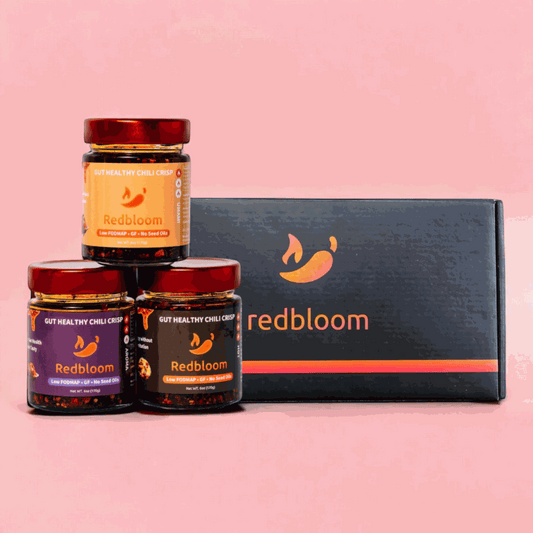
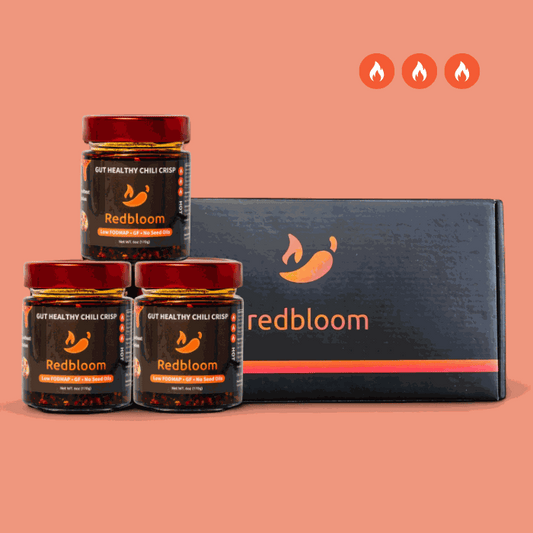
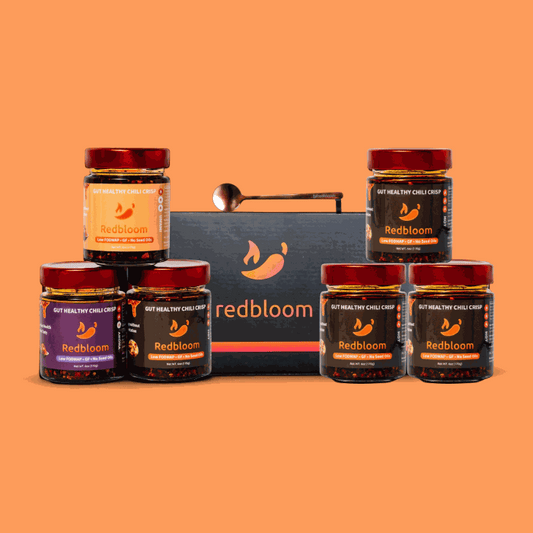
This is exactly the problem that Redbloom Chili Crisp was designed around. Capsaicin is clinically shown to help reduce gut sensitivity over time with careful, gradual exposure, but the challenge with most traditional chili products is that they deliver too much capsaicin too fast. That sudden flood of heat can trigger discomfort before your gut has had any chance to adapt, which keeps your TRPV1 receptors in a reactive state rather than moving them toward desensitization.
Redbloom addresses this by microencapsulating capsaicin in oleic acid from avocado oil, creating a protective cushion around the active compound. This gentler delivery system is designed to reduce the sharp initial spike of receptor activation, making the experience more manageable for sensitive guts while still providing the consistent, low-level exposure that supports tolerance-building over time.
The product also follows a 3-phase protocol: Mild Umami, then Medium Aroma, then Hot Dopamine. This structured progression mirrors what the research suggests works best, starting at a level your receptors can handle and gradually increasing intensity as your gut adapts. Rather than asking your nervous system to jump straight to high heat, the protocol walks it there step by step.
Key Takeaways
- Spice tolerance builds through TRPV1 receptor desensitization: repeated low-dose exposure trains your nerve receptors to respond less intensely over time.
- Dose, duration, and timing all determine whether your body becomes more or less sensitive to capsaicin, so consistency matters more than intensity.
- People with IBS or visceral hypersensitivity have more reactive TRPV1 receptors, making a slow, gradual approach especially important.
- Tolerance can fade if you stop eating spicy food regularly, so maintaining a consistent habit helps preserve the adaptation you have built.
- Pairing spice with starch or fat, tracking symptoms, and backing off during flares are practical ways to build tolerance without triggering setbacks.
Frequently asked questions
How long does it take to build a real spice tolerance?
It varies quite a bit from person to person, but researchers think meaningful desensitization tends to develop over several weeks of consistent, regular exposure rather than days. The key word is consistent: occasional spicy meals are less likely to produce lasting adaptation than eating small amounts of heat a few times per week. If you have IBS or gut sensitivity, the process may take longer, and it is worth going more slowly than you think you need to.
Can you lose spice tolerance if you stop eating spicy food?
Yes, this seems to be the case for most people. TRPV1 receptors can reset toward their baseline sensitivity when capsaicin exposure stops, which is why a spicy meal after a long break often feels much more intense than it did before. The good news is that rebuilding tolerance tends to go faster the second time around, since your receptors have adapted before.
Is spice tolerance the same for everyone?
Not at all. People vary quite a bit in how many TRPV1 receptors they have and how reactive those receptors are, which means some people naturally handle heat better than others. Gut health also plays a role: people with IBS or visceral hypersensitivity tend to have more reactive receptors in their digestive tract, making capsaicin feel harsher even at doses that others handle easily.
Is it safe to try building spice tolerance if I have IBS?
For many people with IBS, a slow and structured approach to capsaicin exposure may actually help reduce gut hypersensitivity over time. That said, everyone's gut is different, and what works well during a calm period may backfire during a flare. It is worth consulting with a healthcare provider before making deliberate dietary changes, especially if your symptoms are active or severe. This article is for informational purposes only and is not medical advice.
Why does the same hot sauce feel hotter on some days than others?
Your gut's sensitivity is not fixed from day to day. Stress, sleep, hydration, and the overall state of your digestive system can all influence how reactive your TRPV1 receptors are at any given moment. During an IBS flare or a period of high stress, your gut nerves tend to be more sensitized, which means the same amount of capsaicin can feel significantly more intense than it would on a calm day.
Does eating spicy food with fat or starch actually help?
It seems to, yes. Capsaicin is fat-soluble, which means fat can help carry it away from sensitive tissue and slow its absorption. Starch physically dilutes the concentration of capsaicin in contact with your gut lining. Neither approach eliminates the response, but pairing spice with these foods tends to make the experience gentler and more manageable, which is useful when you are in the early stages of building tolerance.
References
Medical disclaimer
Medical Disclaimer: This article is for informational purposes only and is not intended as medical advice. Always consult with a qualified healthcare provider before making dietary changes or if you have a medical condition.