Introduction
Love the idea of enjoying spicy food but your mouth and gut say otherwise? You're not alone. Many people wonder how long it takes to build spice tolerance, especially those with sensitive stomachs or IBS. The good news is that your body can adapt to capsaicin (the compound that makes peppers hot) through a process called desensitization. Research shows that with consistent, gradual exposure, most people can build meaningful spice tolerance within weeks to months. This article breaks down the science behind spice tolerance, realistic timelines, and safe strategies to help you work up to your heat goals without triggering painful flare-ups.
What Is Spice Tolerance and How Does It Work?
Spice tolerance happens when your TRPV1 receptors (heat and pain sensors in your mouth, throat, and gut) become less reactive to capsaicin over time. Think of it like building calluses on your hands from regular work.
When you first eat something spicy, these receptors fire intensely, sending "burning" signals to your brain. But with repeated exposure, the receptors undergo desensitization, a protective mechanism that reduces their sensitivity [1]. Research shows this process involves calcium-dependent changes that can make the receptors less responsive to the same amount of heat [2,4].
The key is that recovery from desensitization requires time and specific cellular processes. Studies show it takes 5-10 minutes for complete receptor recovery after intense capsaicin exposure, and this recovery depends on cellular energy processes [3].
Why Building Spice Tolerance Takes Time
1) Receptor Desensitization Happens in Phases
TRPV1 receptors don't just shut off instantly. Research shows desensitization occurs within the first 20 seconds of capsaicin exposure, but the process involves complex signaling pathways [1]. Your receptors need time to reset between exposures.
- Fast desensitization: happens within seconds [1,8]
- Recovery phase: requires 5-10 minutes for full restoration [3]
- Long-term adaptation: develops over days to weeks [7]
2) Cellular Recovery Mechanisms
Your receptors need to literally rebuild certain molecules to function properly again. Studies show this recovery requires ATP-dependent processes and can be influenced by various cellular factors [3,9].
- Protein synthesis and recycling takes time [5]
- Calcium regulation must be restored [2,4]
- Surface receptor expression needs to recover [5]
3) Individual Variation in Response
Not everyone's receptors work the same way. Research shows that people respond differently to repeated capsaicin exposure based on their individual receptor sensitivity and recovery patterns [7,10].
- Some people naturally have fewer reactive receptors
- Recovery speed varies between individuals [5]
- Gut conditions can affect tolerance building [7]
Common Signs You're Building Tolerance
You'll know your tolerance is improving when you notice these changes:
- The same spice level feels less intense over time
- Burning sensation fades more quickly after eating
- Less sweating or other heat responses
- Reduced gut discomfort from previously challenging foods
- Ability to enjoy slightly spicier dishes without distress
Why Some People Build Tolerance Faster
Genetics and Baseline Sensitivity
Some people start with naturally less sensitive TRPV1 receptors, giving them a head start on spice tolerance. If you've always handled mild heat reasonably well, you'll likely progress faster than someone who finds black pepper challenging.
Gut Health Status
People with healthy, non-inflamed digestive systems typically build tolerance more easily. Those with IBS, GERD, or other gut conditions may need to go slower and may experience more variability in their progress.
Consistency of Exposure
Regular, small exposures work better than occasional "spice challenges." Research shows that steady, low-dose exposure is more effective for building lasting tolerance than sporadic high-dose attempts [7].
What the Science Says: Key Findings
Human studies provide helpful insights into realistic timelines for building spice tolerance:
14-Day Protocol Results: Research with human volunteers showed that twice-daily low-dose capsaicin exposure for 14 days produced significant desensitization without changes in receptor levels [7]. This suggests functional tolerance can develop in just two weeks with consistent exposure.
Dose-Dependent Recovery: Studies found that low capsaicin doses (1 μM) allowed rapid recovery within 20 minutes, while high doses (10 μM) delayed recovery for extended periods [5]. This supports the "start low, go slow" approach.
Reversible Process: Research shows that spice tolerance is maintained through regular exposure but can fade if you stop eating spicy foods regularly [1,7]. The receptors can regain their original sensitivity over time.
Immediate Strategies During Tolerance Building
1) Dairy Products: Milk, yogurt, or ice cream contain casein proteins that can help wash capsaicin away from receptors, providing faster relief than water.
2) Sugar Solutions: A spoonful of sugar or honey can help neutralize some of the burning sensation by potentially interfering with receptor activation.
3) Starchy Foods: Bread, rice, or crackers can help absorb oils containing capsaicin and provide a physical buffer in your mouth and stomach.
4) Wait It Out: Remember that acute desensitization happens within 20 seconds to a few minutes [1]. Sometimes the best strategy is simply waiting for your receptors to calm down naturally.
Long-Term Strategies to Build Tolerance Safely
1) Start with Micro-Doses
Begin with barely detectable amounts of mild peppers or hot sauce. Research supports low-dose exposure as the most effective approach [7]. Increase only when your current level feels completely comfortable.
2) Maintain Consistent Schedule
Aim for small amounts of spice every day or every other day rather than occasional large doses. Studies show regular exposure is key to building lasting tolerance [7].
3) Support Overall Gut Health
Keep your digestive system in good shape with adequate fiber, hydration, and stress management. A healthy gut baseline makes tolerance building easier and more comfortable.
How Redbloom Fits In
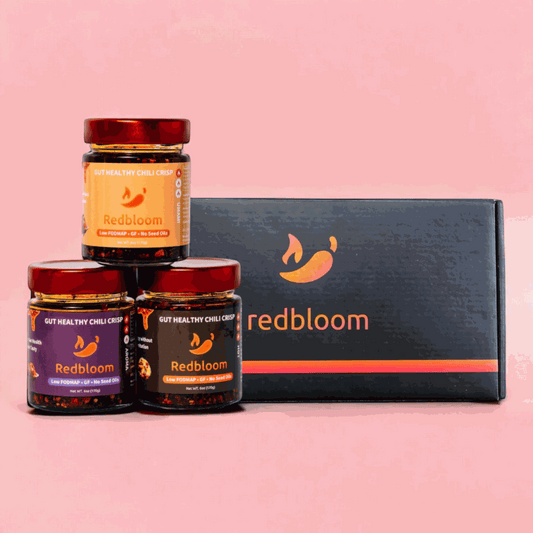
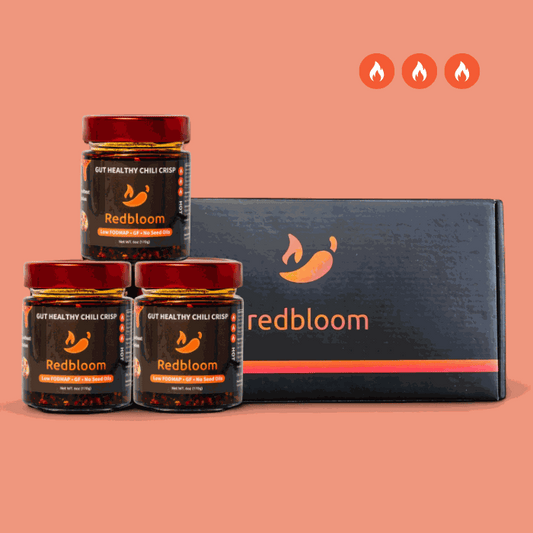
For those interested in building long-term gut resilience, Redbloom's chili crisp offers a unique approach. Capsaicin is clinically proven to reduce gut sensitivity, but traditional chili products can initially trigger flare-ups. Redbloom addresses this by microencapsulating capsaicin in oleic acid from avocado oil, creating a protective cushion that's gentler on sensitive guts. Our 3-phase protocol (Mild Umami → Medium Aroma → Hot Dopamine) is designed to gradually build tolerance, helping reduce gut hypersensitivity that underlies IBS symptoms. Learn more about Redbloom's approach.
FAQ
1) How long does it realistically take to build spice tolerance?
Research shows functional desensitization can begin within 14 days of consistent low-dose exposure [7]. However, building meaningful tolerance to moderately spicy foods typically takes 4-8 weeks of regular practice. People with sensitive stomachs may need 2-3 months to see substantial progress.
2) What happens if I stop eating spicy food for a while?
Your tolerance will gradually decrease as your receptors return to their baseline sensitivity. This process is reversible, so you can rebuild tolerance again with consistent exposure [7]. Most people notice decreased tolerance after 2-4 weeks without spicy foods.
3) Why do some people seem naturally better at handling spice?
Individual differences in TRPV1 receptor sensitivity, genetics, and past exposure history all play roles. Some people simply start with less reactive receptors or have more efficient recovery mechanisms [5,7].
4) Should I push through the discomfort to build tolerance faster?
No, research supports gradual exposure over aggressive approaches [7]. Pushing too hard can lead to prolonged receptor desensitization that actually slows your progress [5]. Listen to your body and increase intensity only when comfortable.
Conclusion
Building spice tolerance is absolutely possible with patience and the right approach. Research shows that consistent, low-dose exposure can produce meaningful desensitization within 2-8 weeks for most people. Remember that everyone's timeline is different, and those with sensitive stomachs may need to go slower. Focus on gradual progress rather than speed, and celebrate small victories along the way. With time and consistency, you can expand your spice comfort zone and enjoy foods that once seemed impossibly hot.
Medical Disclaimer: This article is for informational purposes only and is not intended as medical advice. Always consult with a qualified healthcare provider before making dietary changes or if you have a medical condition.
Bibliography
[1] Vlachova V, Teisinger J, Susankova K, et al. A 'cute' desensitization of TRPV1. Current Neuropharmacology. 2011. DOI: 10.2174/157015911795596612
[2] Bhave G, Zhu W, Wang H, et al. Activation of protein kinase C reverses capsaicin-induced calcium-dependent desensitization of TRPV1 ion channels. Journal of Neuroscience. 2004. DOI: 10.1523/JNEUROSCI.4506-03.2004
[3] Liu B, Zhang C, Qin F. Functional Recovery from Desensitization of Vanilloid Receptor TRPV1 Requires Resynthesis of Phosphatidylinositol 4,5-Bisphosphate. Journal of Neuroscience. 2005. DOI: 10.1523/JNEUROSCI.5749-04.2005
[4] Numazaki M, Tominaga T, Takeuchi K, et al. Structural determinant of TRPV1 desensitization interacts with calmodulin. Proceedings of the National Academy of Sciences. 2003. DOI: 10.1073/pnas.1337252100
[5] Tian Q, Hu J, Xie C, et al. Recovery from tachyphylaxis of TRPV1 coincides with recycling to the surface membrane. Proceedings of the National Academy of Sciences. 2019. DOI: 10.1073/pnas.1819635116
[7] Nolden AA, McGeary JE, Hayes JE. Inducible desensitization to capsaicin with repeated low-dose exposure in human volunteers. Physiology & Behavior. 2024. DOI: 10.1016/j.physbeh.2024.114463
[8] Rosenbaum T, Gordon-Shaag A, Munari M, Gordon SE. Ca2+/Calmodulin Modulates TRPV1 Activation by Capsaicin. Journal of General Physiology. 2004. DOI: 10.1085/jgp.200308906
[9] Mohapatra DP, Nau C. Regulation of Ca2+-dependent Desensitization in the Vanilloid Receptor TRPV1 by Calcineurin and cAMP-dependent Protein Kinase. Journal of Biological Chemistry. 2005. DOI: 10.1074/jbc.M410917200
[10] Petrushenko D, Abushik P, Sibarov D, Antonov S. Resensitization of TRPV1 channels after the P2 receptor activation in sensory neurons of spinal ganglia in rats. Frontiers in Cellular Neuroscience. 2023. DOI: 10.3389/fncel.2023.1192780