How to Reduce Bloating Quickly (What Actually Works)
If you want to know how to reduce bloating quickly, the research points to a few strategies that genuinely move the needle.

Introduction
If you're searching for how to reduce bloating quickly, you already know the feeling: that tight, pressurized discomfort that makes your waistband feel two sizes too small by midafternoon It can be a daily disruption that affects what you eat, how you feel, and how much you enjoy your life.
Bloating usually comes from one of a few culprits: excess gas produced by bacteria fermenting undigested food, slowed gut motility (meaning food moves through your system more slowly than it should), or something called visceral hypersensitivityWhen the nerves in your gut are extra reactive, making normal sensations like gas or fullness feel painful or uncomfortable.. That last one is especially common in IBS and helps explain why some people feel intensely bloated even when there isn't a dramatic amount of gas present. Your gut's alarm system is simply turned up too high.
The good news is that researchers have been studying this seriously, and a clearer picture is emerging of what actually helps. It's less about miracle supplements and more about finding the right combination of strategies for your particular gut.
The Case for Probiotics: What the Research Actually Shows
Probiotics have become one of the most studied tools for bloating relief, and the evidence is genuinely encouraging, though with some important nuance. The biggest takeaway from recent research is that combination probiotics tend to work better than single-strain options.
A 2023 meta-analysis published in Gastroenterology pooled data from 25 trials involving nearly 2,000 IBS patients and found that combination probiotic formulas produced significantly lower bloating scores compared to placebo, while single Bifidobacterium strains alone did not show the same benefit [4]. A separate network meta-analysis of over 9,000 participants reinforced this, identifying specific strains like Bacillus coagulans as ranking among the most effective for both overall IBS symptom relief and bloating in particular [5, 7].
More recently, a randomized controlled trial tested a multi-species synbiotic (a combination of probiotics and a prebiotic compound) in 350 adults with self-reported bloating. After six weeks, 72.3% of participants in the synbiotic group reported rarely or never experiencing bloating, compared to 55.9% in the placebo group [2]. Researchers think the mechanisms include crowding out gas-producing bacteria, improving how quickly food moves through the gut, and dialing down visceral hypersensitivity.
Even a single-strain probiotic, Bacillus velezensis BV379, showed meaningful results in a recent double-blind trial: 38.9% of people taking it saw improvement in bloating versus just 17.9% on placebo, and importantly, it didn't disrupt the rest of the gut's microbial community [1].
What This Means for You
- Look for multi-strain or synbiotic formulas rather than single-strain products when targeting bloating.
- Give probiotics at least six to eight weeks before judging whether they're working.
- Strains like Bacillus coagulans and Lactobacillus acidophilus DDS-1 appear particularly well-studied for IBS-related symptoms [5, 6].
The Low-FODMAP Diet: A Powerful (but Temporary) Tool
If probiotics are the long game, the low-FODMAP diet is often the faster route to relief. FODMAPs are a group of fermentable carbohydrates found in foods like wheat, onions, garlic, apples, and certain legumes. In people with sensitive guts, these carbohydrates ferment rapidly in the colon, producing gas and drawing in water, which together create that familiar bloated, uncomfortable feeling.
A 2025 systematic review of 14 randomized controlled trials found that most IBS studies showed significant improvements in bloating, abdominal pain, and quality of life on a low-FODMAP diet compared to control diets [10]. The effect tends to show up within three to four weeks, which makes it one of the more reliably quick options for people willing to commit to the dietary changes.
The catch is that the diet is genuinely restrictive, and following it long-term without guidance can lead to nutritional gaps and may actually reduce the diversity of beneficial bacteria in your gut [10]. Researchers recommend working with a registered dietitian who can guide you through the elimination phase and then carefully reintroduce foods to find your personal triggers. The goal isn't to avoid FODMAPs forever. It's to figure out which specific ones your gut objects to, so you can build a sustainable, less restricted diet over time.
A Simple Starting Point
If you want to experiment before seeing a dietitian, some of the highest-FODMAP foods to temporarily reduce include garlic, onion, wheat-based bread, apples, and cow's milk. Swapping these for lower-FODMAP alternatives like rice, oats, lactose-free dairy, and most leafy greens can give you a sense of whether this approach is worth pursuing further.
Layering Strategies for Faster, Lasting Relief
Research on functional bowel disorders suggests that combining approaches tends to work better than relying on any single intervention. A 2025 trial in adults with functional constipation or diarrhea found that a multi-strain probiotic supplement significantly reduced bloating severity and its interference with daily life, while also producing measurable shifts in gut bacteria composition, including increases in beneficial species like Faecalibacterium prausnitzii [3]. That kind of microbiome shift takes time, which is why pairing a probiotic with dietary adjustments often produces faster perceived relief than either approach alone.
A few additional strategies that seem to help, at least for many people:
- Eating more slowly reduces the amount of air swallowed during meals, which is a surprisingly common contributor to bloating.
- Gentle movement after meals, even a short walk, may help stimulate gut motility and reduce gas buildup.
- Reducing carbonated drinks and sugar alcohols (found in many "diet" or "sugar-free" products) can cut a significant source of fermentable gas for sensitive guts.
- Stress management matters more than most people expect. The gut and brain communicate constantly, and high stress tends to amplify gut sensitivity.
None of these are dramatic interventions, but layered together with a targeted probiotic and some dietary awareness, they tend to add up to meaningful, sustained relief rather than a quick fix that fades.
How Redbloom Helps
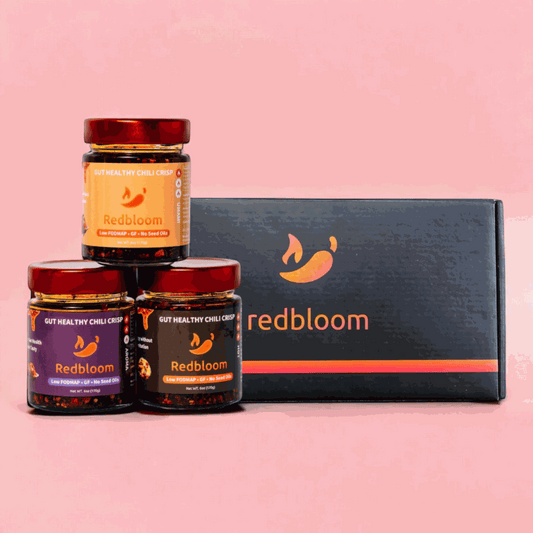
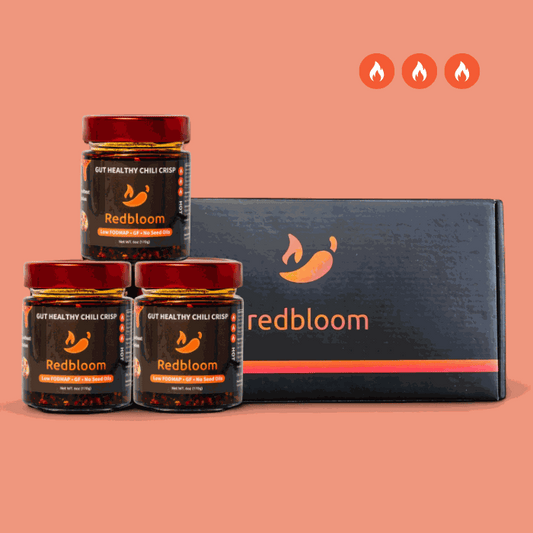
If you've been navigating bloating and gut sensitivity, you've probably learned to approach new foods with caution, and spicy foods in particular can feel like a gamble. That tension is exactly what Redbloom Chili Crisp was designed around. Capsaicin, the active compound in chili peppers, activates receptors in your gut lining and research shows that with careful, gradual exposure it helps reduce gut sensitivity over time. The problem with most traditional chili products is that they deliver too much capsaicin too fast, which can trigger discomfort before your gut has had any chance to adapt.
Redbloom addresses this by microencapsulating capsaicin in oleic acid from avocado oil, creating a protective cushion around the active compound. This means the capsaicin releases more gradually as it moves through your digestive system, making the experience considerably gentler on sensitive guts than a standard chili oil or hot sauce. It's a meaningful difference for anyone who loves the flavor of chili crisp but has had to give it up because of how their gut responds.
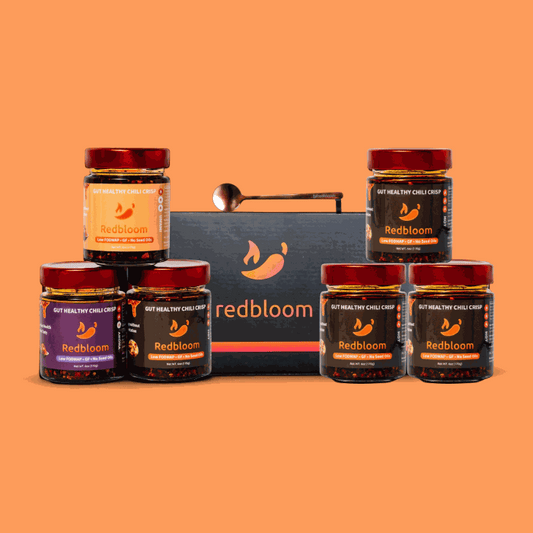
The approach is structured around a 3-phase protocol: Mild Umami, then Medium Aroma, then Hot Dopamine. Rather than starting at full intensity and hoping for the best, the protocol is designed to build your tolerance gradually and sustainably, giving your gut time to adapt at each stage before moving to the next.


Key Takeaways
- Combination probiotics outperform single-strain formulas for bloating relief in IBS, with strains like Bacillus coagulans showing particularly strong evidence.
- The low-FODMAP diet can produce meaningful bloating relief within a few weeks, but works best short-term and with dietitian guidance.
- Layering strategies (probiotics plus dietary changes plus lifestyle habits) tends to produce better results than any single intervention alone.
- Gradual capsaicin exposure may help reduce gut hypersensitivity over time, but the delivery method matters for sensitive guts.
- Give any gut intervention at least six to eight weeks before deciding whether it's working, and track your symptoms to spot patterns.
Frequently asked questions
What is the fastest way to reduce bloating?
There's no single instant fix, but a few things tend to help relatively quickly. Cutting high-FODMAP foods like garlic, onion, and wheat can reduce gas production within a few days for many people [10]. Gentle movement after meals and slowing down while eating can also make a noticeable difference. For longer-term relief, a multi-strain probiotic taken consistently for six to eight weeks has solid evidence behind it [2, 4].
Do probiotics actually help with bloating?
Research suggests they can, particularly combination probiotic formulas. A meta-analysis of 25 trials found significantly lower bloating scores with combination probiotics versus placebo in IBS patients [4]. A more recent trial found that 72.3% of people taking a multi-species synbiotic reported rarely or never experiencing bloating after six weeks, compared to 55.9% on placebo [2]. Single-strain products tend to show weaker effects, so strain selection and formulation seem to matter quite a bit.
Is the low-FODMAP diet worth trying for bloating?
For many people with IBS, it's one of the most effective dietary tools available. A 2025 systematic review found significant improvements in bloating and abdominal pain across most IBS studies using the low-FODMAP diet [10]. The main caveats are that it's restrictive and can affect gut microbiome diversity if followed long-term, so most researchers recommend using it as a short-term diagnostic tool with dietitian support rather than a permanent eating pattern.
Which probiotic strains are best for bloating?
Network meta-analyses suggest Bacillus coagulans ranks particularly highly for bloating and overall IBS symptom relief [5, 7], while Lactobacillus acidophilus DDS-1 scores well for broader IBS symptom severity [5]. Multi-species combinations tend to outperform single strains across the board [4, 8]. A newer strain, Bacillus velezensis BV379, also showed meaningful results in a recent randomized trial specifically targeting abdominal bloating [1].
Can spicy food make bloating worse?
It depends on your gut's current sensitivity. Capsaicin activates nerve receptors throughout the digestive tract, and for people with heightened gut sensitivity, a large or sudden dose can amplify discomfort. That said, research suggests that gradual, low-dose capsaicin exposure over time may actually help reduce gut hypersensitivity rather than worsen it. The key seems to be the delivery method and the pace of introduction, rather than spice being inherently off-limits.
How long does it take for probiotics to reduce bloating?
Most clinical trials run for six to eight weeks, and that's roughly the timeframe where meaningful improvements tend to emerge [1, 2, 3]. Some people notice changes sooner, and some take longer. The general guidance from researchers is to give any probiotic intervention at least six weeks of consistent use before deciding whether it's helping, since the microbiome shifts that drive improvement take time to develop [3].
References
- Garvey SM, Blonquist TM, Brutscher LM, Walsh DM, Kaden VN, Beckman DB, et al. Dietary Supplementation with the Probiotic Bacillus velezensis BV379 Decreases Abdominal Bloating Without Perturbing the Commensal Gut Microbiota: A Randomized, Double-Blind, Placebo-Controlled Trial in Healthy Adults. Journal of the American Nutrition Association 2026.
- Allegretti JR, Kassam Z, Kelly CR, Grinspan A, El-Nachef N, Van Den Elzen C, et al. A Randomized, Placebo-Controlled Trial Evaluating Multi-Species Synbiotic Supplementation for Bloating, Gas, and Abdominal Discomfort. Nutrients 2026.
- Bang WY, Moon JS, Kim H, Lee HB, Kim D, Shin M, et al. Therapeutic Modulation of the Gut Microbiome by Supplementation with Probiotics (SCI Microbiome Mix) in Adults with Functional Bowel Disorders: A Randomized, Double-Blind, Placebo-Controlled Trial. Microorganisms 2025.
- Goodoory V, Khasawneh M, Black C, Quigley E, Moayyedi P, Ford A. Efficacy of Probiotics in Irritable Bowel Syndrome: Systematic Review and Meta-analysis. Gastroenterology 2023.
- Xie P, Luo M, Deng X, Fan J, Xiong L. Outcome-Specific Efficacy of Different Probiotic Strains and Mixtures in Irritable Bowel Syndrome: A Systematic Review and Network Meta-Analysis. Nutrients 2023.
- McFarland LV, Karakan T, Karatas A. Strain-Specific and Outcome-Specific Efficacy of Probiotics for the Treatment of Irritable Bowel Syndrome: A Systematic Review and Meta-Analysis. EClinicalMedicine 2021.
- Author names not individually listed in source. Efficacy for Irritable Bowel Syndrome: A Systematic Review and Network Meta-Analysis. Not specified in source 2022.
- Wu Y, Li Y, Zheng Q, Li L. The Efficacy of Probiotics, Prebiotics, Synbiotics, and Fecal Microbiota Transplantation in Irritable Bowel Syndrome: A Systematic Review and Network Meta-Analysis. Nutrients 2024.
- Shang X, E FF, Guo KL, Li YF, Zhao HL, Wang Y, et al. Effectiveness and Safety of Probiotics for Patients with Constipation-Predominant Irritable Bowel Syndrome: A Systematic Review and Meta-Analysis of 10 Randomized Controlled Trials. Nutrients 2022.
- Kuźmin L, Kubiak K, Lange E. Efficacy of a Low-FODMAP Diet on the Severity of Gastrointestinal Symptoms and Quality of Life in the Treatment of Gastrointestinal Disorders: A Systematic Review of Randomized Controlled Trials. Nutrients 2025.
Medical disclaimer
Medical Disclaimer: This article is for informational purposes only and is not intended as medical advice. Always consult with a qualified healthcare provider before making dietary changes or if you have a medical condition.