Why Does Milk Actually Help With Spice (and Does Water Make It Worse)?
Does milk help with spicy food? Research shows it really does, and the science behind why is more interesting than you'd expect.

Introduction
Before we talk about what helps, it helps to understand what's actually happening when spice hits your mouth. The heat you feel isn't a temperature thing. It's a chemical reaction triggered by capsaicinThe active compound in chili peppers that binds to pain receptors and creates a burning sensation., the compound that makes chili peppers hot.
Capsaicin latches onto receptors called TRPV1A pain and heat receptor found throughout the mouth, throat, and gut that capsaicin activates, sending a burning signal to the brain., which are essentially your body's heat alarm system. When capsaicin binds to them, your brain interprets it as fire, even though nothing is actually burning [9]. The result is that familiar, urgent need to put the flames out.
Here's the catch: capsaicin is hydrophobic, meaning it repels water. It's oil-soluble by nature, which is why reaching for a glass of water tends to do very little. At best, water rinses the surface of your mouth temporarily. At worst, it may spread the capsaicin around, touching more receptors and briefly amplifying the sensation. Water isn't making spice chemically worse, but it's also not solving the problem [3].
What Milk Actually Does to Capsaicin
Milk works through a completely different mechanism than water, and researchers have been piecing together exactly why. The short version: proteins in milk seem to physically grab capsaicin molecules and pull them away from your pain receptors.
The star of the show is casein, the main protein in cow's milk. Studies suggest casein binds to capsaicin through a combination of hydrogen bonding and hydrophobic interactions, essentially wrapping around the capsaicin molecule and trapping it [1]. One study found a binding constant for the casein-capsaicin complex that indicates a strong, spontaneous attraction between the two, with roughly 97% encapsulation efficiency under lab conditions [1].
In practice, this means casein acts a bit like a sponge, soaking up free capsaicin in your mouth before it can keep activating those TRPV1 receptors. Research with 89 participants found that higher casein concentrations reduced the maximum perceived burn intensity, and casein outperformed whey protein at doing so [2].
Whey proteins, the other major protein family in dairy, also help. Beta-lactoglobulin, a common whey protein, binds capsaicin through hydrophobic interactions [6], and alpha-lactalbumin forms complexes with it as well [7]. But across multiple studies, casein consistently comes out ahead [2][4][8].
Does Fat Actually Matter?
For years, the popular explanation was that the fat in whole milk dissolved the oil-soluble capsaicin and carried it away. It's a logical theory, but the research suggests it's only part of the story, if it's part of the story at all. One study directly compared whole milk and skim milk and found they performed similarly at reducing oral burn [3]. Another study found that dairy and plant-based milk proteins reduced burn beyond what fat content alone could explain [5]. Researchers now think protein is doing most of the heavy lifting, with fat playing a smaller supporting role than previously assumed.
Water, Soda, and Other Drinks: How Do They Stack Up?
A well-designed study tested seven common beverages against capsaicin burn, including skim milk, whole milk, seltzer water, cherry Kool-Aid, non-alcoholic beer, cola, and plain water [3]. Every drink reduced burn to some degree, simply by rinsing the mouth and temporarily diluting the capsaicin. But the differences were meaningful.
Whole milk and skim milk produced the largest reductions in burn, followed by cherry Kool-Aid, which researchers think may work partly through sugar interactions with the capsaicin receptor. Plain water and seltzer were the least effective. Beer and cola landed somewhere in the middle [3].
So water doesn't actively make spice worse in a chemical sense. But it's the least effective option on the list, and for someone with a sensitive gut already dealing with the aftermath of a spicy meal, that distinction matters. Reaching for milk instead of water is a genuinely better call.
It's also worth noting that plant-based milks with meaningful protein content, like soy milk, may offer some relief through similar protein-binding mechanisms, though the research on dairy proteins is currently more robust [5].
What This Means If You Have IBS or a Sensitive Gut
If you have IBS or tend toward gut sensitivity, the burn from spicy food isn't just a mouth problem. Capsaicin activates TRPV1 receptors throughout your digestive tract, and for people whose gut nerves are already more reactive than average, that can translate to cramping, urgency, or discomfort well after the meal is over.
Pairing spicy food with a casein-rich dairy product, think a glass of milk, a side of yogurt, or a cooling raita, may help reduce how much free capsaicin is available to activate those receptors, starting in the mouth and potentially continuing as the food moves through your system. The evidence is strongest for oral burn reduction, but the underlying mechanism, protein binding to capsaicin, applies wherever the two come into contact [1][2].
A few practical notes for sensitive eaters:
- Cow's milk, particularly higher-casein options like regular milk rather than heavily processed varieties, seems to offer the most benefit based on current research [4][4].
- Whole milk and skim milk appear roughly equivalent for burn relief, so if you're lactose-sensitive, a lower-fat option with lactase enzyme added may work just as well [3].
- Timing matters. Drinking milk during or immediately after a spicy bite gives the proteins the best chance to intercept capsaicin before it fully activates your receptors [2].
- If dairy doesn't agree with you, a high-protein plant milk may offer some relief, though the evidence for dairy proteins is currently stronger [5].
None of this is a guarantee, and individual responses to both spice and dairy vary. But for most people, the science gives a clear answer: milk is a genuinely useful tool, and it works through real chemistry, not just a cooling placebo effect.
How Redbloom Helps
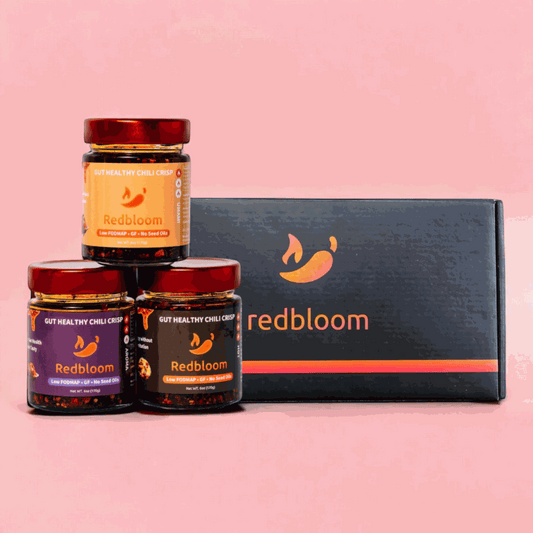
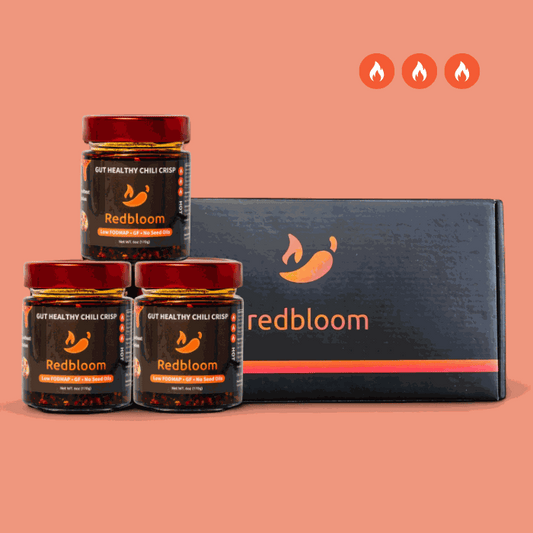
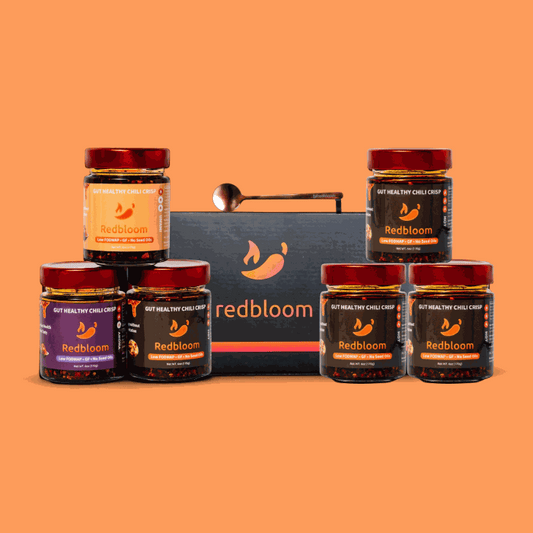
Understanding the science behind spicy food cravings is one thing. Finding a way to enjoy capsaicin that actually works with your gut is another. That's the idea behind Redbloom chili crisp, a gut-health-focused chili crisp built around the same capsaicin research discussed in this article.
For those interested in building long-term gut resilience, Redbloom Chili Crisp offers a unique approach. Capsaicin activates TRPV1 receptors, and is clinically proven to help reduce gut sensitivity over time with careful exposure. But traditional chili products often deliver too much capsaicin too fast, which can trigger discomfort before your gut has a chance to adapt.
Redbloom addresses this by microencapsulating capsaicin in oleic acid from avocado oil, creating a protective cushion that's gentler on sensitive guts. Our 3-phase protocol (Mild Umami → Medium Aroma → Hot Dopamine) is designed to gradually build tolerance, helping reduce the gut hypersensitivity for those with sensitive guts.
Key Takeaways
- Milk reduces spicy food burn through protein binding, not primarily through fat, with casein being the most effective protein studied.
- Water doesn't chemically worsen spice, but it's the least effective beverage for relief because capsaicin repels water.
- Whole milk and skim milk perform similarly, suggesting you don't need the extra fat to get the benefit.
- For IBS or sensitive gut situations, pairing spicy food with a casein-rich dairy product during or right after eating may help manage the experience.
- Timing matters: drinking milk during or immediately after spicy bites gives proteins the best chance to intercept capsaicin.
Frequently asked questions
Does milk help with spicy food, or is it just a myth?
It's not a myth. Multiple studies suggest milk genuinely reduces the burning sensation from capsaicin, and researchers have identified a likely mechanism: proteins in milk, particularly casein, bind to capsaicin molecules and reduce how much is available to activate your pain receptors [1][2]. It's real chemistry, not just a placebo effect.
Why does water not help with spicy food?
Capsaicin is hydrophobic, meaning it repels water. Water rinses the surface of your mouth but doesn't bind to or neutralize capsaicin the way milk proteins do. In a head-to-head comparison of seven beverages, plain water was among the least effective at reducing burn [3]. It won't make things dramatically worse, but it's the wrong tool for the job.
Is whole milk better than skim milk for spice relief?
Probably not by much. One study found whole milk and skim milk produced similar reductions in capsaicin burn, which suggests protein content matters more than fat content [3]. More recent research supports this, finding that dairy proteins reduce oral burn beyond what fat alone can explain [5]. So if you prefer lower-fat dairy, you're likely not missing out on meaningful relief.
Can plant-based milks help with spicy food burn?
Possibly, if they contain enough protein. Research suggests that proteins in both dairy and plant-based milks contribute to capsaicin burn reduction [5]. Soy milk, which is relatively high in protein, may offer more relief than oat or rice milk. That said, the evidence for dairy proteins, especially casein, is currently stronger and more detailed [2][4].
Does eating dairy with spicy food help your gut, or just your mouth?
The research is strongest for oral burn reduction, since that's where most studies measure the effect. But because the protein-binding mechanism isn't limited to the mouth, it's reasonable to think some benefit may continue as food moves through the digestive tract. For people with IBS or gut sensitivity, pairing spicy food with casein-rich dairy is worth trying, though individual responses vary and this isn't a treatment for any medical condition [1][2].
What's the best way to use milk to reduce spice burn?
Drink it during or immediately after eating the spicy food, rather than waiting until the burn peaks. This gives the casein proteins the best opportunity to intercept free capsaicin before it fully activates your receptors [2]. A side of yogurt, a cooling raita, or a glass of milk alongside your meal all work on the same principle.
References
- Razzak M, Cho S. Molecular characterization of capsaicin binding interactions with ovalbumin and casein. Food Hydrocolloids 2022.
- Farah B, Hayes J, Coupland J. The effect of dairy proteins on the oral burn of capsaicin. Journal of Food Science 2023.
- Nolden AA, Lenart G, Hayes JE. Putting out the fire: Efficacy of common beverages in reducing oral burn from capsaicin. Physiology & behavior 2019.
- Gøkhan MA, Sørensen ES, Baad-Hansen L. Role of dairy proteins in the reduction of capsaicin-induced oral burning pain. Physiology & behavior 2023.
- Gaiser J, Hayes J. More than fat: Proteins in dairy and plant milks contribute to the reduction of oral burn from capsaicin. Food Quality and Preference 2023.
- Zhan F, Ding S, Xie W, et al. Towards understanding the interaction of β-lactoglobulin with capsaicin: Multi-spectroscopic, thermodynamic, molecular docking and molecular dynamics simulation approaches. Food Chemistry 2022.
- Romano A, Lajterer C, Shpigelman A, Lesmes U. Bovine alpha-lactalbumin assemblies with capsaicin: Formation, interactions, loading and physiochemical characterization. Food chemistry 2021.
- Gøkhan M, Sørensen E, Baad‐Hansen L. Do milk proteins relieve capsaicin-induced burning sensation in the oral cavity?. Journal of Sensory Studies 2024.
- Hanson S, Newstead S, Swartz K, Sansom M. Capsaicin Interaction with TRPV1 Channels in a Lipid Bilayer: Molecular Dynamics Simulation. Biophysical Journal 2015.
Medical disclaimer
Medical Disclaimer: This article is for informational purposes only and is not intended as medical advice. Always consult with a qualified healthcare provider before making dietary changes or if you have a medical condition.