Why Does Spicy Food Make You Feel So Good After Eating?
Why does spicy food feel good? The answer lives deep in your brain chemistry, and the science is more fascinating than you might expect.

Introduction
Why does spicy food feel good? The short answer is that your brain gets briefly tricked into thinking you're in danger, and then floods your system with feel-good chemicals to compensate. It sounds strange, but the mechanism is surprisingly well-studied.
The whole story starts with a tiny protein in your body called TRPV1A receptor protein found throughout your gut, mouth, and nervous system that detects heat and pain signals, including those triggered by capsaicin.. Think of TRPV1 as a tiny alarm sensor wired into your nerve cells. Its actual job is to warn you when something is dangerously hot, like a stove burner. But capsaicin, the active molecule in chili peppers, fits perfectly into that same sensor and sets off the alarm without any real heat involved [3]. Your brain receives the fire signal and responds accordingly.
Part of that response involves releasing beta-endorphins, your body's homemade opioid-like painkillers. Research in rats found that capsaicin significantly increased the production of a molecule called POMC, which is the direct precursor to beta-endorphins, within just 20 minutes of exposure [1]. Separately, a 2025 study in humans linked spicy food intake to beta-endorphin release and reduced pain perception, suggesting the same pathway seems to operate in people too [7]. It's your nervous system doing what it does best: sensing a threat and mounting a chemical defense.
And here's where the good feeling comes in. Those beta-endorphins don't just kill pain. Researchers think they also feed into the brain's dopamine reward system, the same circuit that responds to things like music, exercise, and food you enjoy [2]. One study found that blocking TRPV1 receptors dramatically reduced dopamine release in the brain's reward center, which suggests the capsaicin receptor plays a direct role in generating that rewarding feeling [4]. In other words, the burn you feel when eating chili crisp may be the very thing that makes you want more of it.
The Opioid Connection: Why Spice Can Feel Like a Natural Painkiller
The word "opioid" tends to sound alarming, but your body produces its own version naturally. Beta-endorphins are endogenous opioids, meaning your body makes them internally, and they bind to the same receptors that respond to morphine. Research has confirmed that TRPV1A receptor protein found throughout your gut, mouth, and nervous system that detects heat and pain signals, including those triggered by capsaicin. and opioid receptors are often found sitting side by side on the same nerve cells, suggesting they're designed to work together [5][8].
This pairing has a fascinating practical consequence. When capsaicin fires up TRPV1 repeatedly, those receptors can become temporarily desensitized, a process researchers call defunctionalization. Essentially, the alarm gets triggered so many times that it stops being as sensitive [3][6]. For people dealing with chronic pain or gut hypersensitivity, this is actually the basis of several capsaicin-based therapies. The initial burn, it turns out, can lead to a quieter nervous system afterward.
A 2025 study found that eating spicy food suppressed participants' perception of pain stimuli, and the researchers pointed to opioid receptor activation as a likely explanation [7]. That analgesic, or pain-relieving, effect may partly explain why some people with IBS report feeling better after meals that include moderate amounts of capsaicin, even though the same compound can cause discomfort if introduced too quickly or in large doses.
It's also worth noting that this isn't purely a physical experience. Research suggests that people who tend to seek out spicy food often score higher on measures of sensation-seeking and reward motivation [10]. The dopamine hit may reinforce the behavior over time, which researchers describe as a kind of "benign masochism," enjoying something that initially signals discomfort because you know it's ultimately safe [10].
What This Means for Your Gut (Especially If You Have IBS)
If you have IBS or a sensitive gut, you've probably had a complicated relationship with spicy food. Maybe it feels great in the moment but causes pain or urgency an hour later. That pattern makes sense when you understand what's happening at the receptor level.
People with IBS often have what researchers call visceral hypersensitivity, meaning the nerve sensors in their gut are more reactive than average. TRPV1 receptors in the gut lining tend to be more numerous and more easily triggered in people with IBS, so even a moderate amount of capsaicin can feel like too much, too fast [2][3].
But here's the more hopeful part of the story. The same desensitization process that makes capsaicin useful as a pain therapy may also apply to the gut. Gradual, consistent exposure to low doses of capsaicin seems to calm those overactive receptors over time, rather than keep them fired up [3][6]. The key word is gradual. Flooding a sensitive gut with capsaicin all at once tends to trigger discomfort before any adaptation can happen. A slow, deliberate approach gives your nervous system time to adjust.
This is also why the delivery method matters. Capsaicin dissolved in oil reaches gut tissue differently than capsaicin in a water-based sauce, and the dose in each bite of a concentrated condiment can vary widely. For people working on gut sensitivity, those variables are worth paying attention to.
How Redbloom Helps
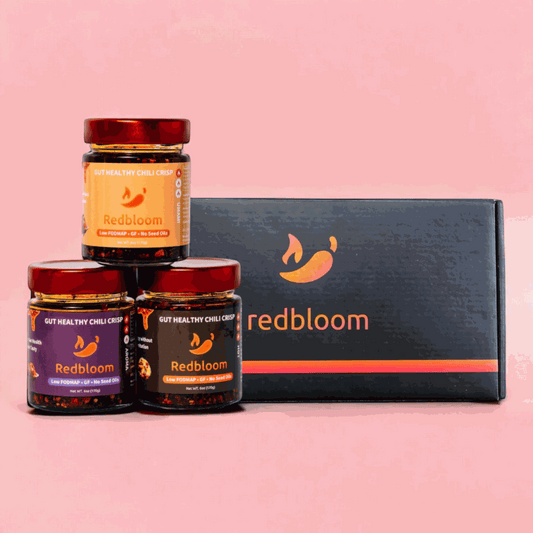
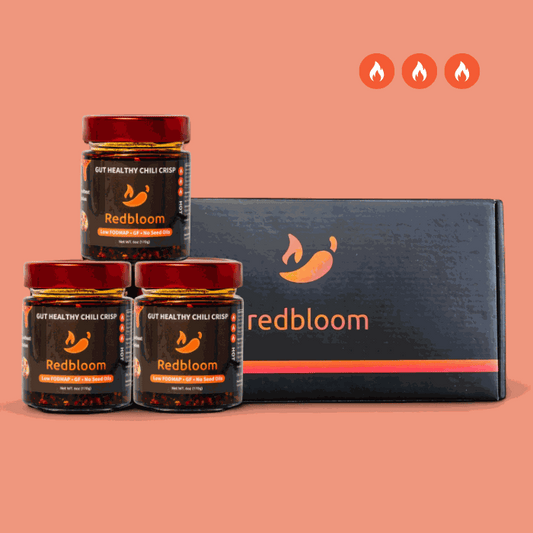
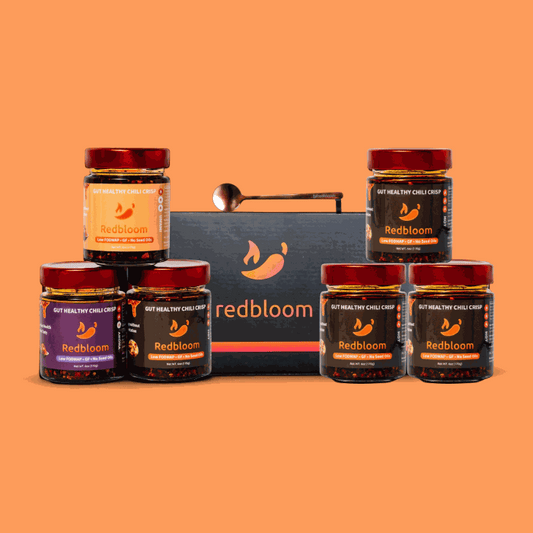
Understanding the science behind capsaicin and TRPV1 is one thing. Putting it into practice with a sensitive gut is another. That's the problem Redbloom Chili Crisp was designed to address.
Most traditional chili products deliver capsaicin in a concentrated, fast-acting form. For a gut that's already reactive, that kind of sudden spike can trigger discomfort before your receptors have any chance to adapt. Redbloom takes a different approach by microencapsulating capsaicin in oleic acid from avocado oil, creating a protective cushion around the active compound. The result is a gentler, more gradual release that may be easier on sensitive gut tissue.
The product is also structured around a 3-phase protocol: Mild Umami, then Medium Aroma, then Hot Dopamine. This progression is designed to build tolerance incrementally, giving your TRPV1 receptors time to desensitize at a pace that works for your gut rather than against it. It's the same principle that underlies capsaicin therapy in clinical research, applied to an everyday condiment you actually want to eat.
If you've been curious about reintroducing spice but nervous about the aftermath, this kind of structured, graduated approach is worth considering as a starting point.
Key Takeaways
- Capsaicin activates TRPV1 receptors, which may trigger beta-endorphin and dopamine release, creating a real neurochemical mood lift after eating spicy food.
- The initial "burn" from capsaicin can lead to receptor desensitization over time, which researchers think may help reduce gut pain sensitivity with gradual exposure.
- People with IBS tend to have more reactive gut TRPV1 receptors, which is why the amount and delivery method of capsaicin matters so much.
- Gradual, consistent exposure to low doses of capsaicin appears to be more effective and comfortable than occasional high-dose spice hits.
- If you have a sensitive gut, starting with a structured, low-dose capsaicin protocol may help you enjoy spicy food without the uncomfortable aftermath.
Frequently asked questions
Why does spicy food feel good even though it causes a burning sensation?
Capsaicin activates TRPV1 receptors, which send a "heat" signal to your brain. In response, your brain may release beta-endorphins, its natural painkilling chemicals, along with dopamine in the brain's reward center [1][2]. Researchers think this neurochemical response is what creates the pleasant, almost euphoric feeling many people notice after eating spicy food. The burn and the pleasure are two sides of the same biological coin.
Is the post-spice mood boost real or just psychological?
It seems to be both, and that's not a bad thing. Studies suggest that capsaicin can stimulate measurable changes in brain chemistry, including increased production of beta-endorphin precursors and dopamine activity in the brain's reward circuit [1][4][7]. At the same time, research on personality and spice preference suggests that the expectation of reward also plays a role [10]. The two effects likely reinforce each other, which may be part of why spicy food can feel genuinely satisfying rather than just tolerable.
Can spicy food actually reduce pain?
Research suggests it might, at least temporarily. A 2025 study found that spicy food intake suppressed participants' perception of pain, and the researchers linked this to opioid receptor activation and beta-endorphin release [7]. Separately, the process of TRPV1 desensitization, where repeated capsaicin exposure temporarily quiets pain receptors, is the basis for several clinical capsaicin therapies used in chronic pain management [3][6]. For most people, the effect is modest and short-lived, but it appears to be a real physiological response rather than a placebo.
Why does spicy food sometimes feel good in the moment but cause gut discomfort later?
The timing difference often comes down to where in your digestive tract the capsaicin is acting. The initial pleasure response happens quickly in the brain, while the gut's reaction, especially in people with IBS or visceral hypersensitivity, can take longer to develop as capsaicin moves through the digestive system [2][3]. If your gut TRPV1 receptors are already overactive, a large or fast dose of capsaicin can trigger cramping or urgency before any desensitization has a chance to kick in. Gradual exposure tends to reduce this mismatch over time.
Does everyone experience the same spice-induced mood lift?
Not quite. Individual differences in TRPV1 receptor density, gut sensitivity, and baseline dopamine activity all seem to shape how intensely someone feels the post-spice glow [2][10]. People with IBS or heightened gut sensitivity may find that discomfort overshadows the pleasant effects, at least initially. Research also suggests that people who regularly eat spicy food may develop a stronger reward association over time, partly through receptor adaptation and partly through learned expectation [10].
Is it safe to use spicy food as a mood booster if I have IBS?
Spicy food is not a treatment for IBS, and anyone with a medical condition should talk to their healthcare provider before making dietary changes. That said, researchers think gradual, low-dose capsaicin exposure may help reduce gut hypersensitivity over time rather than worsen it [3][6]. The amount, delivery method, and pace of introduction all appear to matter significantly. Starting very small and building slowly tends to be a more comfortable approach for sensitive guts than jumping straight to high-heat foods.
References
- Lee JS, Kim SG, Kim HK, Baek SY, Kim CM. Acute Effects of Capsaicin on Proopioimelanocortin mRNA Levels in the Arcuate Nucleus of Sprague-Dawley Rats. Psychiatry investigation 2012.
- Fattori V, Hohmann MS, Rossaneis AC, Pinho-Ribeiro FA, Verri WA. Capsaicin: Current Understanding of Its Mechanisms and Therapy of Pain and Other Pre-Clinical and Clinical Uses. Molecules (Basel, Switzerland) 2016.
- Arora V, Campbell JN, Chung MK. Fight Fire with Fire: Neurobiology of Capsaicin-Induced Analgesia for Chronic Pain. Pharmacology & therapeutics 2021.
- Tian YH, Ma SX, Lee KW, Wee S, Koob GF, Lee SY, et al. Blockade of TRPV1 Inhibits Methamphetamine-induced Rewarding Effects. Scientific reports 2018.
- Vetter I, Wyse BD, Monteith GR, Roberts-Thomson SJ, Cabot PJ. The mu Opioid Agonist Morphine Modulates Potentiation of Capsaicin-Evoked TRPV1 Responses Through a Cyclic AMP-Dependent Protein Kinase A Pathway. Molecular pain 2006.
- Alalami K, Goff J, Grimson H, Martin O, McDonald E, Mirza T, et al. Does Topical Capsaicin Affect the Central Nervous System in Neuropathic Pain? A Narrative Review. Pharmaceuticals (Basel, Switzerland) 2024.
- He B, Shao M, Wu J, Wang J, Wei Z, Chen L, et al. Analgesic Effect and Neural Mechanism of Spicy Food Intake. Social cognitive and affective neuroscience 2025.
- Roohbakhsh A, Shamsizadeh A. Opioids and TRPV1 Receptors. Neuropathology of Drug Addictions and Substance Misuse 2016.
- Uçuk C, Spence C. Spicy Personality: On the Relationship Between Personality Traits and the Preference for Spicy Foods. Foods (Basel, Switzerland) 2026.
Medical disclaimer
Medical Disclaimer: This article is for informational purposes only and is not intended as medical advice. Always consult with a qualified healthcare provider before making dietary changes or if you have a medical condition.