Why Does Spicy Food Make You Need to Poop?
If you've ever wondered why does spicy food make you need to poop urgently, the answer lives in a tiny nerve receptor that treats capsaicin like a five-alarm fire.

Introduction
Why does spicy food make you need to poop urgently? The short answer is that your gut is wired with tiny sensors that treat capsaicin almost like a threat. Those sensors are called TRPV1 receptorsTransient Receptor Potential Vanilloid 1: a nerve channel found throughout the gut that responds to heat, acid, and capsaicin by sending pain and urgency signals to the brain., and they are not evenly distributed throughout your digestive tract. Researchers have found that they are far more concentrated in the rectum and distal colon than anywhere else in the large intestine [2]. That clustering matters, because it means capsaicin hits the finish line of your digestive system hardest.
Think of TRPV1 receptors like smoke detectors. Most of the time they sit quietly. But when capsaicin arrives, they go off all at once, sending a rapid signal through a network of nerves that connects your gut wall to your spinal cord and brain [9]. Researchers think that sudden flurry of signals is what sets off the muscle contractions you feel as urgency [3]. In animal studies, capsaicin reliably triggered what scientists call giant migrating contractions, powerful waves that sweep content toward the rectum and almost always ended in defecation [3]. The effect was fast, predictable, and driven entirely by nerve activation.
A more recent study found that even a small dose of capsaicin applied directly to the rectum produced rapid, short-burst contractions that could trigger defecation, and the whole response was blocked when researchers switched off the parasympathetic nervous system with a drug called atropine [7]. In plain terms: your body's "rest and digest" nerve network is the one pulling the lever, and capsaicin knows exactly how to push it.
Why the Urgency Feels So Sudden and Uncontrollable
The speed of the response surprises a lot of people. You finish a spicy meal and within what feels like minutes, or sometimes just an hour or two, you are sprinting to the bathroom. Part of the reason is anatomy. Most of those TRPV1-packed nerve fibers in your rectum connect directly to the myenteric plexus, the gut's own internal nervous system [9]. Capsaicin can activate that local network almost immediately, which means the motor signal to contract does not have to travel all the way to your brain and back before your colon starts moving.
There is also a reflex loop involved. Studies suggest that TRPV1-positive nerve fibers form a direct functional link between the gut lining and the muscle layers that drive contractions [8][9]. When capsaicin lights up those fibers, the contraction reflex can fire before you are consciously aware of any urgency at all. By the time your brain registers "I need to go," the process is already well underway.
The type of contraction matters too. Capsaicin tends to produce a fast initial squeeze followed by a longer, sustained contraction specifically in the rectum and lower colon [2]. That combination is particularly good at creating the feeling that evacuation cannot wait. Researchers found that neurokinin receptors, part of the signaling chain, are heavily involved in sustaining that second, longer wave [2], which may be why the urgency can feel prolonged rather than a single brief cramp.
Why IBS Makes Everything Worse
If you have IBSIrritable Bowel Syndrome: a common gut condition causing recurring abdominal pain, bloating, and altered bowel habits without visible structural damage., spicy food likely hits you harder than it does most people, and research suggests a clear biological reason. Studies on colonic biopsies found that IBS patients had roughly 3.5 times more TRPV1-expressing nerve fibers than healthy controls, and that increase correlated directly with how much abdominal pain they reported [6]. More receptors means more alarm bells, and more alarm bells means a stronger, faster response to even a modest amount of capsaicin.
Earlier work found the same pattern in patients with rectal hypersensitivity, a condition where the rectum reacts to pressure or heat at much lower thresholds than normal. Those patients had significantly more TRPV1 fibers across all layers of the rectal wall, and the more fibers they had, the lower their threshold for urgency [1]. It is a bit like having a smoke detector with the sensitivity turned all the way up: a little smoke sets it off just as loudly as a lot.
Research applying capsaicin directly to the rectum found that IBS patients who were already viscerally hypersensitive experienced significantly more pain during the procedure than either healthy volunteers or IBS patients without hypersensitivity [5]. The urgency response was similar across groups, but the pain on top of that urgency was amplified in the hypersensitive group, which may explain why spicy food can feel genuinely distressing rather than just inconvenient for some people with IBS.
The good news hidden in this biology is that TRPV1 receptors can desensitize with repeated, controlled exposure. Studies in animal models suggest that capsaicin can actually normalize disordered gut motility in both directions, calming an overactive gut and nudging a sluggish one, depending on the starting state [4]. The key word is "controlled." Too much too fast overwhelms the system; a gradual approach may give the receptors time to recalibrate.
How Redbloom Helps
Capsaicin activates TRPV1 receptors and is clinically shown to help reduce gut sensitivity over time with careful, gradual exposure. The problem with most traditional chili products is that they deliver too much capsaicin too fast, flooding those receptors before your gut has a chance to adapt. The result is the discomfort many sensitive eaters know well.
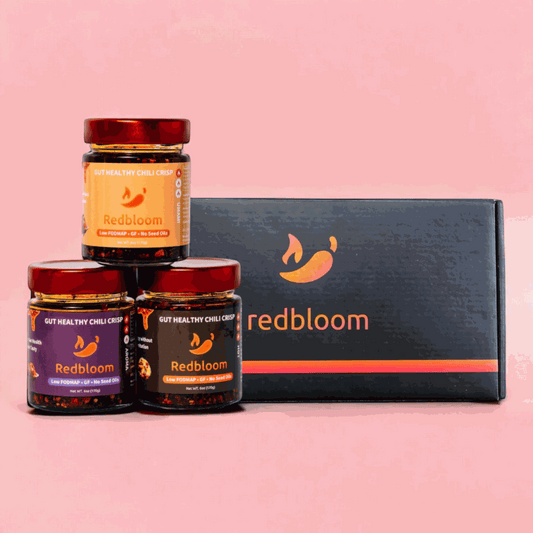
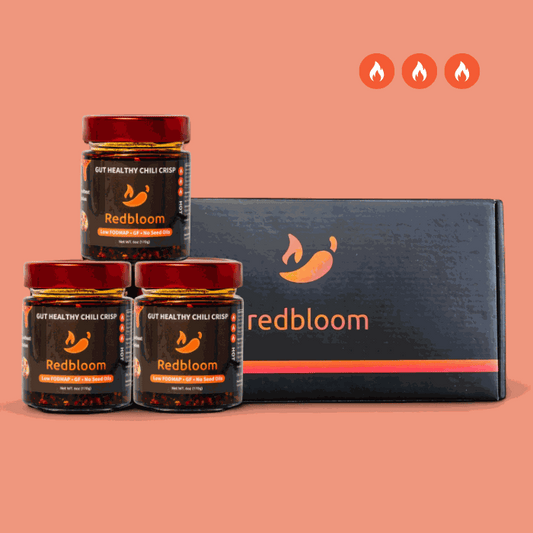
Redbloom Chili Crisp addresses this by microencapsulating capsaicin in oleic acid from avocado oil, creating a protective cushion that is gentler on sensitive guts. Instead of a sudden spike of heat hitting your gut lining all at once, the capsaicin is released more gradually, giving your TRPV1 receptors a chance to respond without being overwhelmed.
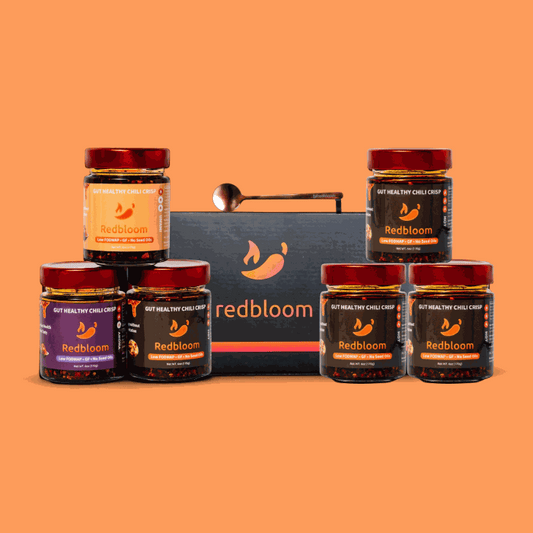
Redbloom also uses a structured 3-phase protocol: Mild Umami, then Medium Aroma, then Hot Dopamine. Each phase is designed to gradually build tolerance and help reduce gut hypersensitivity over time, rather than asking your gut to jump straight to the deep end. For people with IBS or a sensitive digestive system, that kind of structured, incremental approach aligns with what the research suggests about how desensitization actually works.


Key Takeaways
- Capsaicin activates TRPV1 nerve receptors that are densely clustered in your rectum and lower colon, triggering powerful contractions that create urgent bathroom trips.
- People with IBS may have up to 3.5 times more TRPV1 receptors than average, which likely explains why spicy food hits them so much harder.
- The urgency response is driven by your parasympathetic nervous system and can fire before you are consciously aware of needing to go.
- Gradual, controlled exposure to capsaicin may help desensitize TRPV1 receptors over time, potentially reducing urgency and gut hypersensitivity.
- How capsaicin is delivered matters: a slow-release format is gentler on sensitive guts than a sudden high-dose hit from conventional spicy foods.
Frequently asked questions
Why does spicy food make you need to poop urgently even when you only eat a small amount?
Even a small dose of capsaicin can be enough to activate TRPV1 receptors in the rectum and lower colon, which are among the most densely packed sensory nerve fibers in your entire digestive tract [2]. Once those receptors fire, they trigger a reflex contraction through the gut's internal nervous system that can happen faster than you consciously register any sensation [9]. If you have IBS or rectal hypersensitivity, you likely have more of these receptors than average, so even a modest amount of spice can produce a strong response [1][6].
Is the urgent bathroom trip after spicy food actually harmful?
For most people, the urgency is uncomfortable but not harmful. It reflects your gut's nerve system doing exactly what it is designed to do when capsaicin arrives [3]. That said, if you experience frequent or severe urgency, significant pain, or other persistent symptoms alongside spicy food, it is worth speaking with a healthcare provider to rule out underlying conditions. This article is for informational purposes only and is not medical advice.
Why do some people seem totally unbothered by spicy food while others rush to the bathroom?
Individual differences in TRPV1 receptor density and sensitivity play a big role. People with fewer or less reactive receptors simply do not generate as strong a nerve signal from the same amount of capsaicin [10]. Gut conditions like IBS can amplify the response significantly, with research showing IBS patients have roughly 3.5 times more TRPV1-expressing nerve fibers than healthy controls [6]. Regular spice eaters may also have naturally desensitized their receptors over time through consistent exposure [4].
Can eating spicy food regularly actually reduce the urgency over time?
Research suggests it may, with the right approach. Studies in animal models found that capsaicin can normalize abnormal gut motility in both directions, and the mechanism involves gradual TRPV1 desensitization [4]. The key seems to be consistency and dose: starting low and building slowly tends to work better than occasional large exposures. Jumping straight to very spicy food before your gut has adapted is more likely to overwhelm your receptors than to calm them [5].
Does the type of spicy food matter, or is all capsaicin the same?
How capsaicin is delivered seems to matter quite a bit. Capsaicin is fat-soluble, which means oil-based formats can carry it efficiently through the gut. A concentrated dose hitting sensitive tissue all at once is more likely to produce a strong urgency response than the same amount released gradually [2][3]. The format, concentration, and speed of delivery all influence how your TRPV1 receptors respond.
Is there a connection between the spicy food urgency and IBS flares?
Yes, and the connection is well-documented. IBS patients with visceral hypersensitivity experienced significantly more pain during capsaicin stimulation than either healthy volunteers or IBS patients without hypersensitivity [5]. Their elevated TRPV1 receptor density means the same stimulus produces a stronger signal [6]. During an active flare, when gut nerves are already sensitized, even small amounts of spice can push an already reactive system over the edge. Timing and dose management tend to matter more during flare periods.
References
- Chan CL, Facer P, Davis JB, Smith GD, Egerton J, Bountra C, et al. Sensory fibres expressing capsaicin receptor TRPV1 in patients with rectal hypersensitivity and faecal urgency. Lancet (London, England) 2003.
- Matsumoto K, Kurosawa E, Terui H, Hosoya T, Tashima K, Murayama T, et al. Localization of TRPV1 and contractile effect of capsaicin in mouse large intestine: high abundance and sensitivity in rectum and distal colon. American journal of physiology. Gastrointestinal and liver physiology 2009.
- Hayashi K, Shibata C, Nagao M, Sato M, Kakyo M, Kinouchi M, et al. Intracolonic capsaicin stimulates colonic motility and defecation in conscious dogs. Surgery 2010.
- Chen D, Xiong Y, Lin Y, Tang Z, Wang J, Wang L, et al. Capsaicin alleviates abnormal intestinal motility through regulation of enteric motor neurons and MLCK activity: relevance to intestinal motility disorders. Molecular nutrition & food research 2015.
- Akbar A, Yiangou Y, Facer P, et al. Sensitivity testing in irritable bowel syndrome with rectal capsaicin stimulations: role of TRPV1 upregulation and sensitization in visceral hypersensitivity. Gut 2008.
- Akbar A, Yiangou Y, Facer P, Walters JR, Anand P, Ghosh S. Increased capsaicin receptor TRPV1-expressing sensory fibres in irritable bowel syndrome and their correlation with abdominal pain. Gut 2008.
- Cook JB, Piatt R, Burgard E, Thor KB, Marson L. Rapid-Onset, Short-Duration Induction of Colorectal Contractions in Anesthetized, Adult, Male Rats. The Journal of pharmacology and experimental therapeutics 2024.
- Suckow S, Anderson E, Caudle R. Lesioning of TRPV1 expressing primary afferent neurons prevents PAR-2 induced motility, but not mechanical hypersensitivity in the rat colon. Neurogastroenterology & Motility 2012.
- Smith-Edwards KM, Najjar SA, Edwards BS, Howard MJ, Albers KM, Davis BM. Extrinsic Primary Afferent Neurons Link Visceral Pain to Colon Motility Through a Spinal Reflex in Mice. Gastroenterology 2019.
- Malin SA, Christianson JA, Bielefeldt K, Davis BM. TRPV1 expression defines functionally distinct pelvic colon afferents. The Journal of neuroscience : the official journal of the Society for Neuroscience 2009.
Medical disclaimer
Medical Disclaimer: This article is for informational purposes only and is not intended as medical advice. Always consult with a qualified healthcare provider before making dietary changes or if you have a medical condition.