Why Does Your Tongue Go Numb After Spicy Food?
That strange numb feeling you get from a tongue numb after eating spicy food is actually your nervous system doing something surprisingly clever.

Introduction
If you have ever noticed your tongue go numb after eating spicy food, you have stumbled onto one of the more fascinating tricks your nervous system pulls. The culprit is capsaicin, the active compound in chili peppers, and the story of what it does to your mouth is genuinely surprising.
Your tongue is lined with tiny nerve endings that carry a receptor called TRPV1A protein channel on nerve cells that responds to heat, acid, and capsaicin, sending a pain or burning signal to the brain.. Think of TRPV1 as a tiny alarm button. When capsaicin binds to it, the alarm fires and your brain registers burning heat, even though nothing is actually hot. That is the sting you feel in the first few bites of something spicy.
Here is where the numbness comes in. Almost immediately after that alarm fires, calcium floods into the nerve cell through the open TRPV1 channel. That calcium surge is what triggers the receptor to shut itself down, a process researchers call desensitization [5]. The alarm goes off, then it goes quiet. And when enough of your tongue's receptors go quiet at once, the result feels like a mild numbness or tingling [2].
Research confirms that your tongue is the most sensitive region in your entire mouth, likely because it carries a higher density of TRPV1 receptors than your cheeks, lips, or palate [4]. So the numb feeling tends to be strongest right on the tongue itself, and it tends to hit faster there too.
The Science Behind the Numbness: Two Types of Shutdown
Researchers have identified two distinct ways your TRPV1 receptors power down after capsaicin exposure, and understanding both helps explain why the numbness can feel different depending on how much spice you ate and how fast you ate it.
Acute Desensitization
The first type happens almost instantly, within about 20 seconds of your first exposure. Capsaicin opens the TRPV1 channel, calcium rushes in, and that calcium influx triggers a feedback loop that dephosphorylates (essentially switches off) the receptor [5]. It is a built-in protective mechanism, researchers think, designed to prevent your nerve cells from being overwhelmed by too much calcium [8]. This is what causes the rapid fade you notice after the initial burn peaks.
Tachyphylaxis
The second type, called tachyphylaxisA rapid decrease in response to a stimulus after repeated exposures, meaning the same dose produces less and less effect over time., builds up with repeated bites. Each time capsaicin stimulates a TRPV1 receptor, some of those receptors get pulled off the surface of the nerve cell and either recycled or broken down entirely [6][7]. With fewer receptors available on the surface, each subsequent bite tends to feel less intense. Studies in rats recorded this exact pattern in the trigeminal nerve, the main sensory nerve serving your tongue and face, showing progressive quieting of nerve signals with repeated capsaicin exposure [3].
The good news is that this is reversible for most people. Research suggests that TRPV1 receptors recycle back to the cell surface over time, which is why your sensitivity returns after a rest [6]. The numbness is temporary, not a sign that anything is wrong.
Should You Worry? What the Research Says
For most people, a numb or tingly tongue after spicy food is completely normal and resolves on its own within minutes. It is not nerve damage. It is your nervous system doing exactly what it is designed to do.
A 2024 study following healthy volunteers through repeated low-dose capsaicin exposure found that people reported significantly less oral burning over time, even though the number of TRPV1 receptors in their taste buds did not actually decrease [1]. That finding suggests the adaptation happening in your mouth is more nuanced than simply losing receptors. Other mechanisms, possibly changes in how receptors are regulated or how nerve signals are processed, seem to be at work too [1][2].
Research also shows that desensitization at one spot on your tongue tends to generalize. If your front tongue adapts to capsaicin, the reduced sensitivity can spread to other oral sites and even to different concentrations of capsaicin [10]. This is why seasoned spice lovers often describe a broad, overall tolerance rather than just tolerance to one specific dish.
One thing worth knowing: at very high doses, capsaicin can push neurons into a longer-lasting refractory state where they become temporarily unresponsive to a range of stimuli, not just capsaicin [9]. This is the principle behind high-dose topical capsaicin patches used in pain clinics. But the amounts in food, even very spicy food, are nowhere near those clinical doses. Everyday spice tolerance is a gentler, reversible version of the same biology.
If you have IBS or a sensitive gut, the same TRPV1 desensitization that happens on your tongue also occurs throughout your digestive tract. Researchers think this is one reason gradual capsaicin exposure may help reduce gut hypersensitivity over time, though everyone's threshold is different and going too fast can backfire.
How to Build Tolerance Without Overwhelming Your System
The key insight from the research is that low and slow wins. A 2024 human study found that repeated low-dose capsaicin exposure reliably reduced burn ratings over time, while skipping exposure let sensitivity creep back [1]. Occasional spice challenges tend not to build lasting tolerance the way steady, moderate exposure does.
A few practical principles that the science supports:
- Start milder than you think you need to. Your tongue and gut both adapt better when the initial stimulus is manageable, not overwhelming.
- Consistency matters more than intensity. Regular small exposures tend to produce more durable desensitization than occasional large ones [10].
- Give yourself rest days. Receptor recycling takes time. Pushing through every day without breaks may not accelerate tolerance and could cause more discomfort [6].
- Pair spice with food. Eating capsaicin alongside starchy foods slows its contact with sensitive tissues and can make the initial exposure gentler.
If you have IBS or gut hypersensitivity, the same logic applies to your digestive tract. Gradual exposure, not a sudden plunge into ghost peppers, is the approach most likely to help your system adapt without triggering a flare.
How Redbloom Helps
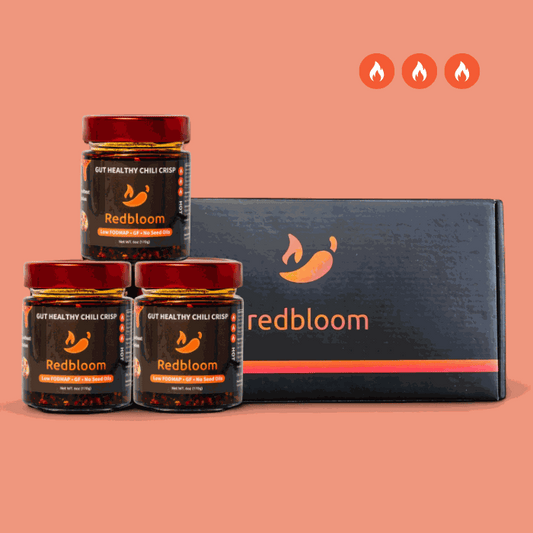
This is exactly the challenge that Redbloom Chili Crisp was designed around. Capsaicin has real potential to help reduce gut sensitivity over time through TRPV1 desensitization, but the problem with most traditional chili products is that they deliver too much capsaicin too fast. That spike can trigger discomfort before your tongue or your gut has had any chance to adapt.
Redbloom addresses this by microencapsulating capsaicin in oleic acid from avocado oil, creating a protective cushion that releases more gradually and tends to be gentler on sensitive systems. Instead of a sudden flood of heat, you get a more measured exposure that gives your receptors time to respond without being overwhelmed.
The product is also built around a 3-phase protocol: Mild Umami, then Medium Aroma, then Hot Dopamine. The idea is to move through increasing heat levels progressively, letting your tolerance build the way the research suggests it should, one manageable step at a time. For people with IBS or gut hypersensitivity who want to work spice back into their lives, that kind of structured, gradual approach tends to make the process feel a lot more sustainable.


Key Takeaways
- The tongue numbness after spicy food is caused by TRPV1 receptors shutting themselves down after capsaicin exposure. It is normal and temporary.
- Your tongue is the most capsaicin-sensitive part of your mouth, which is why the numb feeling tends to be strongest there.
- Two types of shutdown occur: acute desensitization (within seconds) and tachyphylaxis (building with repeated bites). Both are reversible.
- Repeated low-dose exposure tends to build lasting tolerance better than occasional high-dose challenges.
- For people with IBS or gut hypersensitivity, the same gradual approach that trains your tongue can also help your digestive tract adapt to capsaicin over time.
Frequently asked questions
Is it normal for your tongue to go numb after eating spicy food?
Yes, it is completely normal. The numbness happens because capsaicin triggers your TRPV1A protein channel on nerve cells that responds to heat, acid, and capsaicin, sending a pain or burning signal to the brain. receptors to fire and then rapidly shut down, a protective process called desensitization [5]. Your tongue has a particularly high density of these receptors, so it tends to feel the effect most strongly [4]. The sensation should resolve on its own within minutes.
Does the numbness mean capsaicin is damaging your nerves?
For the amounts of capsaicin found in food, researchers do not think the numbness reflects nerve damage. It reflects a temporary, reversible shutdown of TRPV1 receptors [5][6]. The receptors recycle back to the surface of your nerve cells, and sensitivity returns. Very high-dose clinical capsaicin (used in pain patches) can produce a longer-lasting refractory state, but that is a very different context from eating spicy food [9].
Why do some people feel more numbness than others?
Individual differences in TRPV1 receptor density, nerve sensitivity, and possibly genetics all seem to play a role. Research also shows that people who eat spicy food regularly tend to experience less burning and less numbness overall, because repeated exposure gradually desensitizes their receptors [1][10]. Someone trying a very spicy dish for the first time will likely feel far more than a regular spice eater eating the same thing.
Can building spice tolerance on your tongue also help your gut?
Researchers think so, at least for some people. TRPV1 receptors are found throughout your digestive tract, not just your mouth, and the same desensitization process that quiets your tongue receptors appears to occur in gut tissue too [2][8]. For people with IBS-related gut hypersensitivity, gradual capsaicin exposure may help reduce the overactive pain signaling that makes digestion uncomfortable. Going slowly is key, since too much too fast can trigger discomfort before adaptation has a chance to occur [1].
How long does the numbness last?
For most people, the numb or tingly feeling fades within a few minutes to around 15 to 30 minutes after eating. Research on trigeminal nerve activity suggests that after a rest period, receptors begin recovering and sensitivity starts returning [3][6]. If you eat more spicy food during that window, you may notice the burn feels weaker than your first bite, which is tachyphylaxisA rapid decrease in response to a stimulus after repeated exposures, meaning the same dose produces less and less effect over time. in action [2].
What should I do if my tongue stays numb for a long time after spicy food?
Prolonged or unusual numbness that does not resolve within an hour, or numbness accompanied by swelling, difficulty swallowing, or other symptoms, is worth checking with a healthcare provider. This article is for informational purposes only and is not medical advice. Consult with a healthcare provider before making dietary changes, especially if you have a medical condition.
References
- Nolden AA, Lenart G, Spielman AI, Hayes JE. Inducible Desensitization to Capsaicin with Repeated Low-Dose Exposure in Human Volunteers. Physiology & behavior 2024.
- Smutzer G, Devassy RK. Integrating TRPV1 Receptor Function with Capsaicin Psychophysics. Advances in pharmacological sciences 2016.
- Dessirier JM, Simons CT, Sudo M, Sudo S, Carstens E. Sensitization, Desensitization and Stimulus-Induced Recovery of Trigeminal Neuronal Responses to Oral Capsaicin and Nicotine. Journal of neurophysiology 2000.
- Berry DN, Simons CT. Assessing Regional Sensitivity and Desensitization to Capsaicin Among Oral Cavity Mucosae. Chemical senses 2020.
- Touska F, Marsakova L, Teisinger J, Vlachova V. A 'Cute' Desensitization of TRPV1. Current pharmaceutical biotechnology 2011.
- Tian Q, Hu J, Xie C, Mei K, Pham C, Mo X, et al. Recovery from Tachyphylaxis of TRPV1 Coincides with Recycling to the Surface Membrane. Proceedings of the National Academy of Sciences 2019.
- Sanz-Salvador L, Andrés-Borderia A, Ferrer-Montiel A, Planells-Cases R. Agonist- and Ca2+-Dependent Desensitization of TRPV1 Channel Targets the Receptor to Lysosomes for Degradation. The Journal of biological chemistry 2012.
- Vyklický L, Nováková-Tousová K, Benedikt J, Samad A, Touska F, Vlachová V. Calcium-Dependent Desensitization of Vanilloid Receptor TRPV1: A Mechanism Possibly Involved in Analgesia Induced by Topical Application of Capsaicin. Physiological research 2008.
- Fischer MJM, Ciotu CI, Szallasi A. The Mysteries of Capsaicin-Sensitive Afferents. Frontiers in physiology 2020.
- Prescott J. The Generalizability of Capsaicin Sensitization and Desensitization. Physiology & Behavior 1999.
Medical disclaimer
Medical Disclaimer: This article is for informational purposes only and is not intended as medical advice. Always consult with a qualified healthcare provider before making dietary changes or if you have a medical condition.