Why Is Your Gut Bloated Even When You're Eating Healthy?

Bloating from healthy foods causes more confusion than almost any gut symptom, and the science behind it is more interesting than you might expect.
Introduction
Bloating from healthy foods causes real frustration, especially when you have done everything right: more vegetables, more fiber, more whole foods. Yet there you are, uncomfortable and puffy after a meal of broccoli and lentils. The cruel irony is that the very compounds making those foods so good for you are often the same ones feeding your gut bacteria and generating gas.
Here is the short version of what is happening. Your small intestine cannot fully digest certain carbohydrates found in otherwise nutritious foods. Those undigested fragments travel to your colon, where trillions of bacteria eagerly ferment them. That fermentation process is genuinely beneficial for your gut, but it also produces gases as a byproduct. More than 99% of intestinal gas is made up of hydrogen, carbon dioxide, and methane [2]. For most people, that gas moves through without much drama. For people with IBSIrritable Bowel Syndrome: a common gut condition causing abdominal pain, bloating, and changes in bowel habits, often linked to heightened gut sensitivity. or a sensitive gut, the same amount of gas can feel like a balloon inflating inside your abdomen.
Understanding why this happens is the first step toward eating well without paying for it later.
The Foods Most Likely Behind Your Bloating
FODMAPs: The Fermentable Carbohydrates
Researchers use the term FODMAPsFermentable Oligosaccharides, Disaccharides, Monosaccharides, and Polyols: a group of short-chain carbohydrates that are poorly absorbed in the small intestine and rapidly fermented by gut bacteria. to describe a group of short-chain carbohydrates that your small intestine struggles to absorb. Think of foods like garlic, onions, wheat, apples, and most legumes. When these reach your colon undigested, gut bacteria treat them like a feast, and gas is the result [7].
A large systematic review of randomized controlled trials found that a low-FODMAP diet led to meaningful improvements in bloating and abdominal pain for most people with IBS [8]. But here is something worth knowing: not all FODMAPs seem to cause equal trouble. A 2024 reintroduction trial found that fructans (found in wheat and onions) and galacto-oligosaccharides, or GOS (found in beans and lentils), were the subgroups most consistently linked to worsened bloating. Participants reacted to an average of about 2.3 FODMAP subgroups, not all of them [3]. That means a full elimination diet may be more restrictive than you actually need.
Cruciferous Vegetables and the Gas They Generate
Broccoli, Brussels sprouts, cabbage, and their relatives are nutritional powerhouses. They also happen to be rich in raffinose-family oligosaccharides and fermentable fibers that gut bacteria love to break down [2]. Studies confirm that adding cruciferous vegetables to the diet significantly shifts the composition of gut bacterial communities, with specific microbes selectively metabolizing the unique compounds these vegetables contain [9].
The good news is that the same fermentation process generating gas also produces beneficial compounds that may support gut health and reduce inflammation [10]. So the goal is not to avoid these vegetables forever; it is to find the portion size your gut can handle comfortably.
High-Fiber Whole Foods
A high-fiber diet is one of the most consistently recommended dietary patterns for long-term health. It also tends to cause more bloating, at least initially. A secondary analysis of a large feeding trial found that high-fiber dietary patterns reliably increased self-reported bloating compared to lower-fiber diets [6]. Separately, research using detailed genetic sequencing of gut bacteria showed that even a two-week increase in whole-food fiber intake measurably shifted microbiome composition [5].
That shift is actually the point. But when your gut bacteria population is changing rapidly, gas production tends to spike temporarily. Think of it as your microbiome recalibrating to a new fuel source.
Why Your Gut Reacts Differently Than Someone Else's
You and a friend could eat identical bowls of lentil soup and have completely different afternoons. That is not random. Research suggests that your personal microbiomeThe microbiome is the vast community of trillions of bacteria, fungi, and other microbes living in your gut, which play a central role in digestion, immunity, and overall health. composition is a major driver of how much gas you produce from any given food [7].
One study comparing two different prebiotic fibers found that inulin (found in chicory and Jerusalem artichokes) produced significantly more hydrogen gas than pectin (found in apples and citrus), and that the difference was strongly tied to which bacteria were most abundant in each person's gut. Individuals with higher levels of a bacterial family called Lachnospiraceae tended to produce more hydrogen from inulin fermentation [7].
This is why blanket dietary advice can feel so unhelpful. The same food that bloats one person may pass through another without incident. Factors like your history of antibiotic use, your diet over the past several years, and even how much stress you carry can all shape which microbes dominate your gut and how aggressively they ferment incoming food.
There is also the question of gut sensitivity. People with IBS often have what researchers call visceral hypersensitivity, meaning their gut nerves send louder signals in response to normal amounts of gas and movement. Even a modest amount of fermentation can feel disproportionately uncomfortable when those nerve pathways are turned up.
What You Can Actually Do About It
Go Slow with Fiber Increases
If you are adding more vegetables, legumes, or whole grains to your diet, try ramping up gradually over two to four weeks rather than overhauling everything at once. This gives your gut bacteria time to adapt and tends to produce far less transitional bloating.
Identify Your Personal FODMAP Triggers
Rather than eliminating all FODMAPs indefinitely, a structured reintroduction process can help you pinpoint which subgroups actually cause your symptoms. Research suggests most people react to only a handful of FODMAP categories, not every single one [3]. Working with a registered dietitian who specializes in gut health can make this process much more precise and less unnecessarily restrictive. A low-FODMAP approach has solid evidence behind it for short-term symptom relief, though long-term use and its effects on microbiome diversity are still being studied [8].
Cooking Methods Matter
Soaking and rinsing canned legumes before eating them can reduce their fermentable carbohydrate content noticeably. Cooking cruciferous vegetables rather than eating them raw tends to break down some of the cell structures that make fermentation so vigorous, which many people find easier to tolerate [4].
Keep a Simple Food and Symptom Log
Because bloating responses are so individual, tracking what you eat alongside how you feel over one to two weeks can reveal patterns that no general guideline ever could. You may discover that it is not broccoli in general but a large serving of it raw on an empty stomach that is the real culprit.
How Redbloom Helps
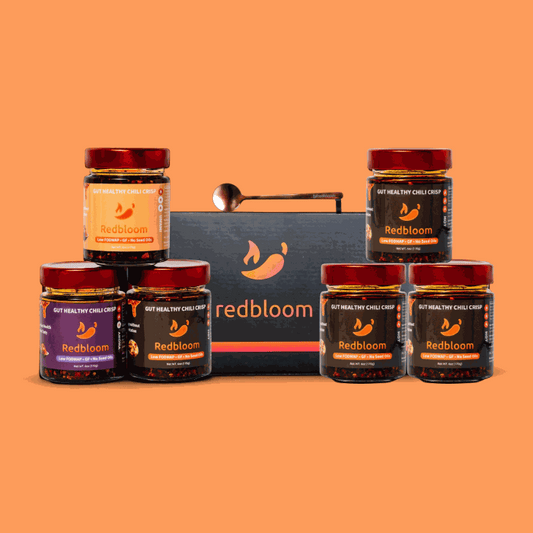
If you have been navigating gut sensitivity, you already know that adding anything new to your diet feels like a calculated risk. Redbloom Chili Crisp was designed with exactly that challenge in mind. Capsaicin, the active compound in chili peppers, has genuine potential when it comes to gut health. Research shows it activates TRPV1 receptors in the gut lining and helps reduce visceral hypersensitivity over time with careful, gradual exposure. The problem with most traditional chili products is that they deliver too much capsaicin too fast, which can trigger discomfort before your gut has had any chance to adapt.
Redbloom addresses this by microencapsulating capsaicin in oleic acid derived from avocado oil. That encapsulation creates a protective cushion around the capsaicin, allowing it to release more gradually as it moves through your system. For people with sensitive guts, that slower, gentler delivery can make a meaningful difference in how the experience actually feels.
The product also follows a structured 3-phase protocol: Mild Umami first, then Medium Aroma, then Hot Dopamine. That progression is intentional. Rather than jumping straight to high heat, the phases are designed to help you build tolerance gradually and sustainably, giving your gut time to adjust at each stage before moving to the next. It is the kind of thoughtful, incremental approach that tends to work well for anyone who has learned the hard way that rushing gut adaptation rarely ends well.


Key Takeaways
- Healthy foods like beans, broccoli, and whole grains produce bloating because gut bacteria ferment their undigested carbohydrates, a process that is normal and often beneficial.
- Your unique microbiome composition largely determines how much gas you produce from any given food, which is why individual responses vary so widely.
- Most people with IBS react to only a few FODMAP subgroups, so targeted restriction tends to be more effective and less disruptive than eliminating all FODMAPs.
- Bloating that spikes when you add more fiber to your diet often reflects a temporary microbiome adjustment rather than a sign that those foods are wrong for you.
- Gradual dietary changes, cooking methods, and working with a gut-specialized dietitian are among the most evidence-supported strategies for reducing bloating without sacrificing nutrition.
Frequently asked questions
Why do I bloat more when I eat healthier foods?
Nutritious foods like legumes, cruciferous vegetables, and whole grains are rich in fermentable carbohydrates that your small intestine cannot fully digest. When these reach your colon, gut bacteria ferment them and produce gas as a byproduct [2]. This process is actually a sign of a well-fed microbiome, but it can feel uncomfortable, especially if your gut is sensitive. The good news is that the bloating often decreases as your gut bacteria adapt to a higher-fiber diet [5].
Are FODMAPs the main cause of bloating from healthy foods?
FODMAPs are a major contributor for many people, particularly those with IBS. These short-chain carbohydrates are poorly absorbed and rapidly fermented by gut bacteria, generating hydrogen and methane gas [1]. However, not every FODMAP triggers symptoms in every person. Research suggests that most people react to roughly 2 to 3 FODMAP subgroups on average, so a full elimination may not always be necessary [3]. Identifying your personal triggers through a structured reintroduction process tends to be more useful than avoiding all fermentable foods indefinitely.
Why does broccoli cause so much gas?
Broccoli and other cruciferous vegetables contain fermentable fibers and compounds called raffinose-family oligosaccharides that gut bacteria actively break down [2]. Research also shows that these vegetables selectively shift gut microbial communities, which can temporarily increase gas production as bacteria adjust [9]. Cooking broccoli rather than eating it raw, and starting with smaller portions, tends to reduce the fermentation intensity for most people.
Is it normal to bloat more when starting a high-fiber diet?
Yes, and it is quite common. When you increase fiber intake, your gut microbiome composition shifts to accommodate the new fuel source. Studies using detailed genetic analysis of gut bacteria have shown measurable microbiome changes within just two weeks of a high-fiber dietary intervention [5]. During that adjustment window, gas production tends to increase temporarily. Ramping up fiber gradually over several weeks rather than all at once can make the transition considerably more comfortable.
How do I figure out which healthy foods are triggering my bloating?
Keeping a food and symptom log for one to two weeks is one of the most practical starting points. Because individual microbiome composition plays such a large role in gas production [7], your triggers may look quite different from someone else's. A structured low-FODMAP elimination and reintroduction protocol, ideally guided by a registered dietitian who specializes in gut health, can help you identify your specific problem foods without restricting your diet more than necessary [8]. This article is for informational purposes only and is not medical advice. Consult with a healthcare provider before making dietary changes, especially if you have a medical condition.
Does a low-FODMAP diet actually work for bloating?
Research suggests it can be effective for short-term symptom relief. A systematic review of randomized controlled trials found that a low-FODMAP diet led to significant improvements in bloating and abdominal pain in most IBS studies compared to control diets [8]. However, long-term use raises questions about nutritional adequacy and potential effects on gut microbiome diversity, so most experts recommend using it as a diagnostic and short-term management tool rather than a permanent eating pattern [1].
References
- Vandeputte D, Joossens M. Effects of Low and High FODMAP Diets on Human Gastrointestinal Microbiota Composition in Adults with Intestinal Diseases: A Systematic Review. Microorganisms 2020.
- Mutuyemungu E, Singh M, Liu S, Rose D. Intestinal Gas Production by the Gut Microbiota: A Review. Journal of Functional Foods 2023.
- Eswaran S, Jencks KJ, Singh P, Rifkin S, Han-Markey T, Chey WD. All FODMAPs Aren't Created Equal: Results of a Randomized Reintroduction Trial in Patients With Irritable Bowel Syndrome. Clinical gastroenterology and hepatology : the official clinical practice journal of the American Gastroenterological Association 2025.
- Bouranis JA, Beaver LM, Jiang D, et al. Interplay between Cruciferous Vegetables and the Gut Microbiome: A Multi-Omic Approach. Nutrients 2022.
- Oliver A, Chase AB, Weihe C, Orchanian SB, Riedel SF, Hendrickson CL, et al. High-Fiber, Whole-Food Dietary Intervention Alters the Human Gut Microbiome but Not Fecal Short-Chain Fatty Acids. mSystems 2021.
- Zhang M, Juraschek SP, Appel LJ, et al. Effects of High-Fiber Diets and Macronutrient Substitution on Bloating: Findings From the OmniHeart Trial. Clinical and Translational Gastroenterology 2020.
- Yu X, Gurry T, Nguyen LTT, Richardson HS, Alm EJ. Prebiotics and Community Composition Influence Gas Production of the Human Gut Microbiota. mBio 2020.
- Kuźmin L, Kubiak K, Lange E. Efficacy of a Low-FODMAP Diet on the Severity of Gastrointestinal Symptoms and Quality of Life in the Treatment of Gastrointestinal Disorders: A Systematic Review of Randomized Controlled Trials. Nutrients 2025.
- Li F, Hullar MA, Schwarz Y, Lampe JW. Human Gut Bacterial Communities Are Altered by Addition of Cruciferous Vegetables to a Controlled Fruit- and Vegetable-Free Diet. The Journal of nutrition 2009.
- Alaba TE, Holman JM, Ishaq SL, Li Y. Current Knowledge on the Preparation and Benefits of Cruciferous Vegetables as Relates to In Vitro, In Vivo, and Clinical Models of Inflammatory Bowel Disease. Current developments in nutrition 2024.
Medical disclaimer
Medical Disclaimer: This article is for informational purposes only and is not intended as medical advice. Always consult with a qualified healthcare provider before making dietary changes or if you have a medical condition.