Introduction
Love that first bite of spicy chili crisp but dread what comes next? You're not alone. Many people notice that spicy food burns more on the second bite, creating an intensifying wave of heat that seems to build with each mouthful. This phenomenon happens because of how your pain receptors respond to capsaicin, the compound that makes peppers hot. While your first bite might feel manageable, subsequent bites can trigger a cascade of nerve responses that amplify the burning sensation. This article explores the fascinating science behind why spicy food burns more on your second bite and shares practical strategies to help you enjoy heat without the overwhelming burn.
What Is Capsaicin and How Does It Affect Your Pain Receptors?
Capsaicin binds to TRPV1 receptors, specialized proteins that detect heat and pain throughout your mouth, throat, and digestive tract. When capsaicin activates these receptors, they send intense burning signals to your brain, even though no actual tissue damage occurs [1].
Here's what happens during spice exposure:
- TRPV1 activation: Capsaicin triggers these heat sensors, creating the familiar burning sensation [1]
- Calcium influx: Activated receptors allow calcium to flood into nerve cells, intensifying the pain signal [3]
- Protective feedback: Your body attempts to protect nerves from calcium overload through a process called desensitization [1]
This receptor system evolved to protect you from actual heat damage, but capsaicin hijacks the same pathway to create a burning sensation without real harm.
Why Spicy Food Burns More on Your Second Bite
1) Acute Desensitization Breakdown
Research shows that TRPV1 receptors undergo acute desensitization within 20 seconds of capsaicin exposure [1]. This should theoretically make subsequent bites less painful, but the process isn't perfect. When desensitization fails or becomes incomplete, your receptors remain highly sensitive to additional capsaicin exposure.
- Calcium overload can disrupt normal desensitization patterns [3]
- High capsaicin concentrations can reactivate previously desensitized channels [3]
2) Protein Kinase Interference
Your body's own signaling molecules can work against desensitization. Studies demonstrate that protein kinase A (PKA) phosphorylation reduces TRPV1 desensitization, keeping receptors more sensitive to repeated capsaicin exposure [2]. When PKA is active, your pain receptors don't shut down as effectively after that first bite.
- PKA prevents normal receptor desensitization at specific protein sites [2]
- This keeps pain pathways active for longer periods [2]
3) Calcium-Dependent Sensitization
The calcium that floods into nerve cells during capsaicin exposure can actually make receptors more sensitive rather than less. Research shows that calcium/calmodulin complexes provide feedback that can either inhibit or enhance TRPV1 activity depending on the circumstances [4]. This creates a scenario where your second bite hits receptors that are primed to respond even more intensely.
- Calcium binding can increase receptor sensitivity in some conditions [4]
- The timing and concentration of capsaicin exposure affects this process [3]
Common Signs Your Receptors Are Overwhelmed
When spicy food burns more on your second bite, you might experience:
- Escalating mouth pain that peaks after several bites
- Increased salivation and mucus production
- Sweating and facial flushing
- A lingering burn that persists even after you stop eating
- Difficulty tasting other flavors in your meal
Why Some People Handle Repeated Spice Better
Genetic Variations: Some people have naturally different TRPV1 receptor expressions or variations in the proteins that control desensitization [2]. These genetic differences explain why your spice-loving friend might handle repeated bites while you reach for milk after bite two.
Adaptation Through Exposure: Regular capsaicin exposure can improve your body's desensitization mechanisms over time. People who eat spicy food frequently may develop more efficient calcium regulation and better receptor recovery processes [7].
Inflammatory Status: Chronic inflammation appears to increase TRPV1 expression and sensitivity, which could make the burning sensation more intense with each bite [8]. Worth noting: the research behind this finding comes from animal studies of airway inflammation, so how directly it applies to eating-related sensitivity isn't fully established – but it points to a plausible pattern.
What the Science Says: Key Findings
Desensitization timing matters: Research shows that TRPV1 desensitization occurs rapidly but requires specific conditions to be effective [1]. When these conditions aren't met, subsequent capsaicin exposure can feel more intense than the initial contact.
Recovery requires energy: Studies demonstrate that functional recovery from capsaicin-induced desensitization requires ATP and the resynthesis of specific cellular components [7]. This means your receptors need time and cellular energy to reset between spicy exposures.
Protein modifications control sensitivity: Research reveals that phosphorylation at specific receptor sites can either increase or decrease capsaicin sensitivity [2,6]. Your body's current biochemical state influences whether that second bite will burn more or less.
Species differences exist: Studies show that even single amino acid changes can dramatically alter capsaicin sensitivity [10], highlighting how individual genetic variations might explain why some people experience more intense burning on repeated bites.
Immediate Relief Strategies
1) Dairy products: Milk, yogurt, or ice cream contain casein proteins that can help wash capsaicin away from receptors and provide cooling relief.
2) Sugar solutions: A spoonful of sugar or honey may help reduce receptor activation and provide some immediate comfort.
3) Starchy foods: Bread, rice, or crackers can help absorb capsaicin and give your receptors a break from continued exposure.
4) Cold temperatures: Ice chips or cold water can provide temporary relief, though the effect may be brief since capsaicin isn't water-soluble.
5) Fat-based solutions: Small amounts of oil or butter may help dissolve capsaicin since it's fat-soluble, potentially reducing receptor contact.
Long-Term Strategies to Reduce Sensitivity
1) Gradual exposure training: Start with very mild heat and slowly increase intensity over weeks. This approach may help your desensitization mechanisms become more efficient and reliable [7].
2) Timing between exposures: Allow adequate recovery time between spicy meals. Research suggests that receptors need time to restore the cellular components necessary for proper desensitization [7].
3) Support overall nerve health: Adequate sleep, stress management, and anti-inflammatory nutrition may help optimize your TRPV1 receptor function and recovery processes.
How Redbloom Fits In
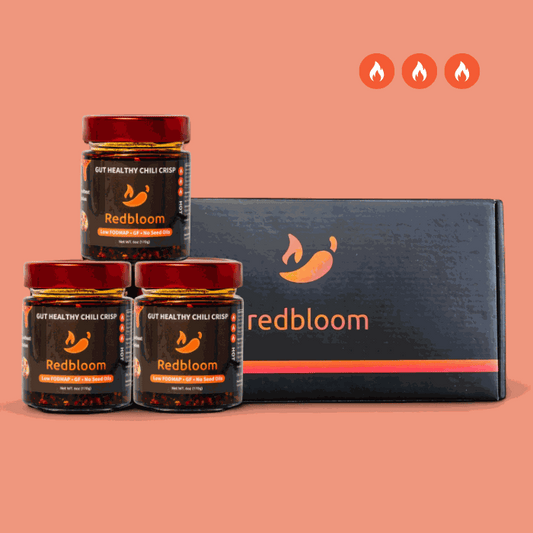
For those interested in building long-term spice tolerance, Redbloom's chili crisp offers a unique approach. Capsaicin is clinically proven to reduce gut sensitivity, but traditional chili products can initially trigger overwhelming sensations. Redbloom addresses this by microencapsulating capsaicin in oleic acid from avocado oil, creating a protective cushion that's gentler on sensitive receptors. Our 3-phase protocol (Mild Umami → Medium Aroma → Hot Dopamine) is designed to gradually build tolerance, helping reduce the hypersensitivity that makes each bite burn more than the last. Learn more about Redbloom's approach.
FAQ
1) Why doesn't desensitization always work to reduce the burn?
Desensitization depends on specific cellular conditions including calcium levels and energy availability [1,7]. When these conditions aren't optimal, or when capsaicin concentrations are very high, the protective desensitization process can fail or become incomplete [3].
2) Can certain medications make spicy food burn more on the second bite?
Research on aspirin's effects on TRPV1 found it actually enhanced tachyphylaxis – meaning it increased how quickly the receptors desensitized during repeated capsaicin exposure [9]. This suggests various substances might affect your receptors' recovery patterns, though the direction isn't always what you'd expect.
3) Is there a limit to how much spice tolerance I can build?
Studies indicate that while you can improve desensitization through gradual exposure, there are individual limits based on your genetic makeup and receptor characteristics [2,10]. Some people will always be more sensitive to capsaicin than others.
4) How long should I wait between spicy meals to avoid the escalating burn?
Research suggests that full receptor recovery requires resynthesis of cellular components, which takes time and energy [7]. Waiting at least several hours between intense spicy exposures may help prevent the cumulative burning effect.
5) Why do some peppers seem to burn more on the second bite than others?
Different peppers contain varying capsaicin concentrations and related compounds that might affect receptor desensitization differently [3]. Some varieties may be more likely to overwhelm your protective mechanisms than others.
Conclusion
Understanding why spicy food burns more on your second bite helps you approach heat more strategically. The science reveals that your pain receptors have complex protective mechanisms that don't always work perfectly, especially with repeated or intense capsaicin exposure. By using immediate relief strategies, building tolerance gradually, and timing your spicy meals thoughtfully, you can enjoy the flavors you love without the escalating burn. Remember that everyone's sensitivity is different, so listen to your body and adjust accordingly.
Bibliography
[1] Touska F, Marsakova L, Teisinger J, Vlachova V. A "cute" desensitization of TRPV1. Current Pharmaceutical Biotechnology. 2011;12(1):122–129.
[2] Mohapatra DP, Nau C. Desensitization of capsaicin-activated currents in the vanilloid receptor TRPV1 is decreased by the cyclic AMP-dependent protein kinase pathway. Journal of Biological Chemistry. 2003. DOI: 10.1074/jbc.M306619200
[3] Vyklicky L, Novakova-Tousova K, Benedikt J, Samad A, Touska F, Vlachova V. Calcium-dependent desensitization of vanilloid receptor TRPV1: a mechanism possibly involved in analgesia induced by topical application of capsaicin. Physiological Research. 2008;57(Suppl 3):S59–68.
[4] Rosenbaum T, Gordon-Shaag A, Munari M, Gordon SE. Ca2+/calmodulin modulates TRPV1 activation by capsaicin. Journal of General Physiology. 2004. DOI: 10.1085/jgp.200308906
[5] Numazaki M, Tominaga T, Takeuchi K, Murayama N, Toyooka H, Tominaga M. Structural determinant of TRPV1 desensitization interacts with calmodulin. Proceedings of the National Academy of Sciences. 2003. DOI: 10.1073/pnas.1337252100
[6] Mandadi S, Numazaki M, Tominaga M, Bhat MB, Armati PJ, Roufogalis BD. Activation of protein kinase C reverses capsaicin-induced calcium-dependent desensitization of TRPV1 ion channels. Cellular Calcium. 2004.
[7] Liu B, Zhang C, Qin F. Functional Recovery from Desensitization of Vanilloid Receptor TRPV1 Requires Resynthesis of Phosphatidylinositol 4,5-Bisphosphate. Journal of Neuroscience. 2005.
[8] Zhang G, Lin RL, Wiggers M, Snow DM, Lee LY. Altered expression of TRPV1 and sensitivity to capsaicin in pulmonary myelinated afferents following chronic airway inflammation in the rat. Journal of Physiology. 2008;586(23):5771–5786. PMID: 18832423.
[9] Maurer K, Binzen U, Mörz H, Bugert P, Schedel A, Treede RD, Greffrath W. Acetylsalicylic acid enhances tachyphylaxis of repetitive capsaicin responses in TRPV1-GFP expressing HEK293 cells. Neuroscience Letters. 2014;563:101–106. doi: 10.1016/j.neulet.2014.01.050.
[10] Chu Y, Cohen BE, Chuang Hh. A single TRPV1 amino acid controls species sensitivity to capsaicin. Scientific Reports. 2020;10:8038. doi: 10.1038/s41598-020-64584-2.
Medical Disclaimer: This article is for informational purposes only and is not intended as medical advice. Always consult with a qualified healthcare provider before making dietary changes or if you have a medical condition.