Why Your 'Healthy' Cooking Oil May Not Be What It Says

Avocado oil fraud at the grocery store is shockingly widespread, and if you're managing IBS or gut issues, what's actually in that bottle matters more than you'd expect.
The Avocado Oil Fraud Problem Is Bigger Than You Think
Avocado oil fraud at the grocery store is not a fringe concern or a food blogger rumor. It is a well-documented, peer-reviewed problem that researchers have been tracking for years. The numbers are striking. A UC Davis study published in Food Control tested 36 private-label avocado oils purchased from 19 stores across the U.S. and Canada. Only 31% were found to be pure, and just 36% met the quality standards advertised on the label [2]. That means roughly two out of every three bottles on the shelf may not be what you think you are buying.
A more recent 2026 study pushed even further into the supply chain, examining 74 commercially processed foods like chips, mayonnaise, and salad dressings that listed avocado oil as an ingredient. An eye-opening 89% of those products showed chemical fingerprints inconsistent with authentic avocado oil [1]. So even when you buy a product marketed as made with avocado oil, the odds are not great that it actually contains much of the real thing.
The researchers found a consistent pattern: lower-cost products had a higher probability of adulteration [2]. That makes intuitive sense. Avocado oil is expensive to produce, and the global supply chain that moves it from grove to bottle passes through multiple countries with variable quality controls. That fragmentation creates plenty of opportunity for substitution.
What Gets Swapped In and How Scientists Catch It
The most common swap is a category of oils called high-oleic seed oilsSeed oils like sunflower or soybean that have been bred or processed to contain high levels of oleic acid, making them chemically similar to avocado oil on basic tests.. High-oleic sunflower, soybean, and rapeseed oils are all significantly cheaper than avocado oil, and because they share a similar fatty acid profile on the surface, they can slip past simple screening methods [2]. Researchers identify the fraud by looking at more specific chemical markers: things like reduced levels of palmitoleic acid, cis-vaccenic acidA fatty acid found naturally in avocado oil but largely absent from seed oils, making it a useful marker for detecting adulteration., and plant sterols called beta-sitosterol and clerosterol, alongside elevated stearic acid and seed-oil sterols [1][10].
One study proposed cis-vaccenic acid specifically as a new detection marker, noting that most seed oil adulterants contain little to no cis-vaccenic acid. When labs report oleic acid and cis-vaccenic acid separately rather than lumping them together, they gain a much clearer picture of whether the oil is genuine [10]. This kind of nuanced chemical detective work is what separates a rigorous audit from a basic label check.
Scientists have developed several sophisticated tools to catch fraud. High-resolution NMR spectroscopy can distinguish authentic avocado oil from olive, canola, high-oleic safflower, high-oleic sunflower, and soybean oils by analyzing the full chemical fingerprint of the oil [3]. Low-field benchtop NMR offers a more affordable version of the same approach, making it practical for industry screening [8]. ATR-FTIR spectroscopy combined with statistical modeling can detect adulteration levels as low as 2% by weight [7]. And a 2025 study introduced laser-induced fluorescence as a portable, non-destructive tool that achieved classification accuracy of 99.06%, with a detection limit as low as 0.0288% adulteration [9]. The science to catch fraud exists. The challenge is applying it consistently across a sprawling global market.
Why This Matters If You Have IBS or Gut Sensitivity
If you are managing IBS or gut sensitivity, you are probably making deliberate choices about what goes into your body. You read labels. You pay more for quality ingredients. The avocado oil fraud problem means those careful choices may not be paying off the way you expect.
Authentic avocado oil is rich in oleic acid, a monounsaturated fatty acidA type of healthy fat with one double bond in its carbon chain, found in high amounts in avocado and olive oil, and associated with anti-inflammatory effects. that researchers think tends to be gentler on the digestive system and may support a less inflammatory gut environment. Seed oil substitutes, by contrast, are often higher in omega-6 polyunsaturated fats, and some researchers suggest that a diet heavy in these fats may contribute to a more pro-inflammatory state in the gut, though the picture is still being worked out in human studies [5].
There is also a practical issue with processed foods. When 89% of products claiming avocado oil as an ingredient are actually using something else [1], the ingredient list you are relying on to manage your symptoms is not accurate. For someone tracking dietary triggers, that kind of hidden substitution can make it genuinely difficult to understand what is causing a flare.
How to Shop More Carefully
- Look for avocado oil that is cold-pressed and sold in dark glass bottles, which tends to correlate with better quality practices.
- Be skeptical of very low prices. Researchers found that cheaper products are more likely to be adulterated [2].
- For processed foods, treat "made with avocado oil" claims with some caution, especially on budget products [1].
- Brands that publish third-party testing results are worth seeking out, since self-reported labels are clearly not reliable on their own.
How Redbloom Helps
If you have IBS or a sensitive gut, you have probably already learned that intention matters less than execution. You can want to eat well, choose the right ingredients, and still end up in discomfort because the delivery mechanism was wrong. That is exactly the challenge Redbloom Chili Crisp was designed around. Capsaicin, the active compound in chili peppers, activates TRPV1 receptors in the gut and is clinically shown to help reduce gut sensitivity over time with careful, gradual exposure. The problem with most traditional chili products is that they deliver too much capsaicin too fast, which can trigger discomfort before your gut has a chance to adapt.
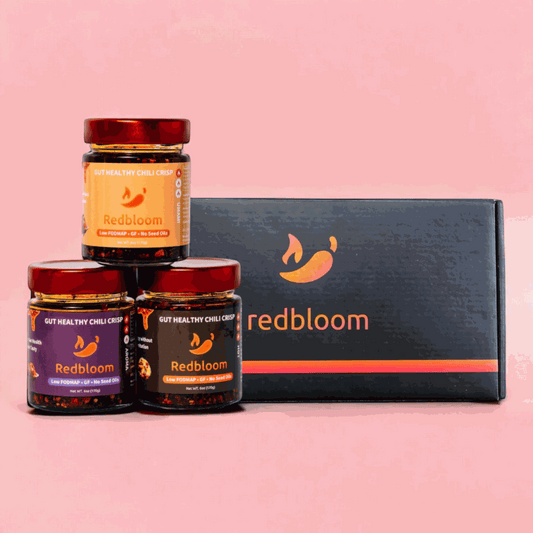
Redbloom addresses this by microencapsulating capsaicin in oleic acid sourced from avocado oil, creating a protective cushion around the active compound. Instead of hitting your gut lining all at once, the capsaicin releases gradually, which is gentler on sensitive systems.
The product is built around a structured 3-phase protocol: Mild Umami first, then Medium Aroma, then Hot Dopamine. The idea is to give your gut time to adapt at each stage before stepping up the intensity. Rather than a one-size-fits-all heat level, this graduated approach is designed to help build tolerance sustainably, so you can enjoy the long-term benefits of capsaicin without the short-term flares that make most people give up on spice entirely.


Key Takeaways
- About 69% of private-label avocado oils tested in U.S. and Canadian stores were adulterated or below quality standards, according to UC Davis research.
- 89% of processed foods labeled as containing avocado oil showed chemical profiles inconsistent with the real thing in a 2026 study.
- Common adulterants are high-oleic seed oils that mimic avocado oil on basic tests but differ in their full fatty acid and sterol profiles.
- For gut-sensitive shoppers, hidden oil substitutions in processed foods can make it harder to identify dietary triggers.
- When buying avocado oil, look for cold-pressed, third-party tested products and treat unusually low prices as a warning sign.
Frequently asked questions
How widespread is avocado oil fraud at the grocery store?
Research suggests it is quite common. A UC Davis study found that only 31% of private-label avocado oils purchased from U.S. and Canadian stores were pure, and just 36% met advertised quality standards [2]. A separate 2026 study found that 89% of processed foods labeled as containing avocado oil showed chemical fingerprints inconsistent with the real ingredient [1]. These findings suggest fraud is widespread across both standalone oils and packaged food products.
What oils are typically used to adulterate avocado oil?
The most common substitutes appear to be high-oleic seed oils, including high-oleic sunflower, soybean, and rapeseed oils. These are cheaper to produce and share enough surface-level similarity with avocado oil to pass basic testing [2][4]. Researchers can distinguish them using more detailed chemical markers like cis-vaccenic acid levels and sterol profiles, which differ meaningfully between authentic avocado oil and its common adulterants [10].
Can I tell if my avocado oil is real just by looking at it?
Not reliably. Color, smell, and taste can offer some hints, but adulterated oils are often specifically chosen because they look and smell similar to the real thing. High-oleic seed oils in particular can be difficult to distinguish without laboratory testing [3][5]. Your best practical options are to buy from brands that publish third-party testing results, choose cold-pressed oils in dark glass bottles, and be cautious about unusually low prices [2].
Does it matter which oil I use if I have IBS?
It may. Authentic avocado oil is high in oleic acid, a monounsaturated fat that researchers think tends to be gentler on the digestive system. Seed oil substitutes are often higher in omega-6 polyunsaturated fats, and some research suggests these may contribute to a more pro-inflammatory gut environment, though human studies are still developing. For people tracking dietary triggers, hidden oil substitutions in processed foods can also make it harder to identify what is causing symptoms [1].
How do scientists detect avocado oil fraud?
Several methods have been validated. High-resolution NMR spectroscopy can analyze the full chemical fingerprint of an oil and distinguish avocado oil from common adulterants [3]. Low-field benchtop NMR offers a more affordable screening option [8]. ATR-FTIR spectroscopy combined with statistical modeling can detect adulteration as low as 2% by weight [7]. A 2025 study introduced laser-induced fluorescence, which achieved classification accuracy of 99.06% and could detect adulteration as low as 0.0288% [9]. The challenge is applying these tools consistently across a fragmented global supply chain.
Are processed foods labeled 'made with avocado oil' trustworthy?
Research suggests caution is warranted. A 2026 study examined 74 commercially processed foods including chips, mayonnaise, and salad dressings that listed avocado oil as an ingredient. Eighty-nine percent showed chemical profiles inconsistent with authentic avocado oil [1]. This means the ingredient claims on many packaged foods may not accurately reflect what is inside, which is a particular concern for people making deliberate dietary choices to manage gut symptoms.
References
- Lopez-Alvarez N, Li X, Vizgordiski B, Wang S. Authenticity of avocado and olive oils used as ingredients in commercially processed foods. Applied Food Research 2026.
- Green H, Wang S. Purity and quality of private labelled avocado oil. Food Control 2023.
- Tang F, Green HS, Wang SC, Hatzakis E. Analysis and Authentication of Avocado Oil Using High Resolution NMR Spectroscopy. Molecules (Basel, Switzerland) 2021.
- Jin H, Wang Y, Lv B, Zhang K et al. Rapid Detection of Avocado Oil Adulteration Using Low-Field Nuclear Magnetic Resonance. Foods 2022.
- Fernando D, Madja ARA, Azizah N, Hastuti AAMB, Rohman A. Distinguishing avocado oil quality based on fatty acid profile using PCA: A review of influencing factors and research gaps. Journal of food and drug analysis 2025.
- Jiménez-Sotelo P, Hernández-Martínez M, Osorio-Revilla G, Meza-Márquez OG, García-Ochoa F, Gallardo-Velázquez T. Use of ATR-FTIR spectroscopy coupled with chemometrics for the authentication of avocado oil in ternary mixtures with sunflower and soybean oils. Food additives & contaminants. Part A, Chemistry, analysis, control, exposure & risk assessment 2016.
- Tang F, Banker T, Green HS, Wang SC, Hatzakis E. Analysis and authentication of avocado oil by low-field benchtop NMR spectroscopy and chemometrics. Journal of food science 2024.
- Bavali A, Rahmatpanahi A, Chegini R. Quantitative detection of adulteration in avocado oil using laser-induced fluorescence and machine learning models. Microchemical Journal 2025.
- Green H, Wang S. Cis-vaccenic acid: New marker to detect seed oil adulteration in avocado oil. Food Chemistry Advances 2022.
Medical disclaimer
Medical Disclaimer: This article is for informational purposes only and is not intended as medical advice. Always consult with a qualified healthcare provider before making dietary changes or if you have a medical condition.